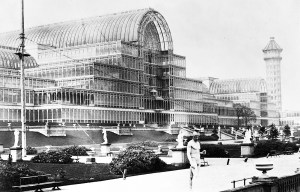
Here’s Alice’s band, reminding us why a life on the seven seas might be the coolest thing ever:
And here’s just Alice, not doing anything. Well, nearly. She only has photos taken at slightly interesting moments:
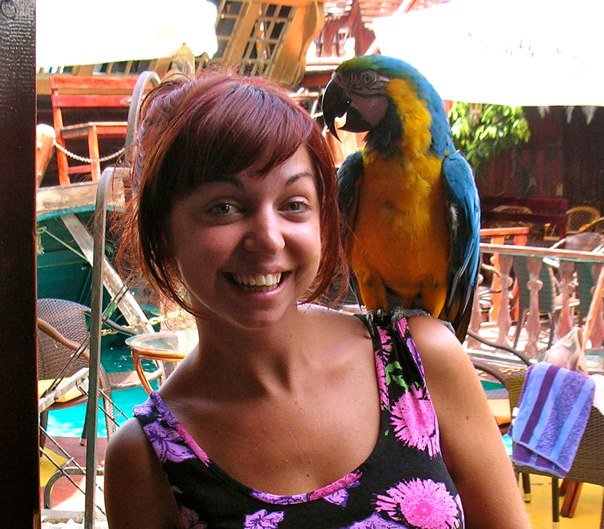

Here’s Alice’s band, reminding us why a life on the seven seas might be the coolest thing ever:
And here’s just Alice, not doing anything. Well, nearly. She only has photos taken at slightly interesting moments:
Here is another blog post, with words in it. You can read it and decide what you think it means, but what it means for you won’t be the same as what it meant for me, because words aren’t thoughts or things but ways of describing thoughts and things – and however carefully we use them, we can only ever hope to make an approximate match with what goes on inside another person’s head.
At least, that’s what I’ve always thought. And I wasn’t alone: the sentiment has been expressed more eloquently many times by more original thinkers than me, including but not limited to Benjamin Franklin (“Words may show a man’s wit, but actions his meaning”), George Bernard Shaw (“Words are only postage stamps delivering the object for you to unwrap”), Voltaire (“One great use of words is to hide our thoughts”) and Albert Einstein (“I rarely think in words at all. A thought comes, and I may try to express it in words afterward.”).
We all use words to hide our thoughts. Of course we do. If I’m asked a difficult question, or made to think about something that makes me uncomfortable, my instinctive response is to come up with an articulate, beautifully-composed answer that communicates precisely nothing at all, but has a joke at the end so I get away with it, at least for now.
So if language hides our thoughts, what is the use of, say, talking cures? Aren’t we just dancing around the reality of our existential angst when we sit on a sofa and pour out a stream of words to another person?
Well, maybe. But I had a conversation with a psychiatrist recently (not as part of a medical consultation), and he told me that for psychotic people, language is what shapes their whole world. All the confabulations, all the paranoid convictions that form the basis of the psychotic’s experience, are built from words. That’s why mad people talk to themselves, or hear voices: their alternate worldview doesn’t have its location in thoughts or actions or feelings or things, but in words. Isn’t that interesting, if it’s true, which it sounds like it should be? And the corollary of that is that words are more important than I think they are: that words can change the shape of our thoughts, rather than just inadequately expressing them. And if they can change the shape of our thoughts, they can change the shape of us.
All of this coalesced in my mind when I read a tweet by Dan the other day. He’d come up with a breautiful thought overnight, but couldn’t quite remember it: And I thought yes, that’s exactly how it works. Language is much, much more powerful than my reductive analysis gives it credit for. My words may not express me, but they can change me. And they can change you – just not in ways that I can predict.
(I think that’s why poetry can be so powerful. The act of choosing the exact, the only, words that express your idea make misinterpretation more likely, but that in turn allows the reader to infer a meaning that is personal to them. Poetry is the most pared-down way of using words that there is, and sometimes the fewer words you use, the more you say. Which brings us back to where we came in, but via an interesting diversion.)
I promised months ago that I’d write about the Rough Guide to Cyprus and why it’s no good at all, and then I forgot, and then I remembered but didn’t have the book to hand in order to quote it. But now I do, and flicking through it I discover I’m every bit as bemused by it as I was at the time.
It may be that Rough Guides are not designed for people like me, who just want to go on holiday. Here is a short quiz which will help you to determine whether you are the kind of person the Rough Guide to Cyprus might be aimed at:
Question 1
Do you look down on everyone else who has travelled to your holiday destination at the same time as you?
Question 2
Do you describe yourself as a traveller, rather than a tourist?
If you answered mostly YES, you may get on with The Rough Guide to Cyprus better than I did. I found it pompous, snobbish, humourless and ill-conceived. I first noticed this when I was reading the section about Cypriot cuisine. It says:
Food throughout Cyprus is generally hearty rather than refined, and on the mainstream tourist circuit at least will get monotonous after a few days. In many respects resort food – especially in the South – is the unfortunate offspring of generic Middle Eastern, and 1960s British, cooking at its least imaginative.
Well, that’s simple enough – just don’t eat at any “resorts”, “especially in the South”. Got that? Never mind that people have varied tastes and palates (personally, I like “generic Middle Eastern” food more than almost any other kind). Never mind that even smallish Cypriot towns on the “mainstream tourist circuit” offer a range of international cuisine as wide as anything you’d find in an English town of twice the size. No, Cypriot food in any of the places you’re actually likely to be staying (there’s a reason it’s called the tourist circuit) is monotonous and unimaginative.
(There’s a lot of this guff about the “mainstream tourist circuit”, incidentally. The writers don’t seem keen on your visiting any of the places on which Cyprus’s economy depends for a substantial part of its income, preferring to recommend remote spots which you have to drive to, environmental considerations clearly playing second fiddle to the traveller’s desire for an authentic experience, whatever that is.)
It was in Cyprus that I first tasted halloumi, which is one of my favourite foods in the world. Surely, I thought, they can’t be rude about halloumi. Everyone like halloumi.
Unfortunately, inferior rubber halloumi – full of added yeast and powdered (cow) milk, squeaking on the teeth when chewed – abounds; when you finally get the real thing (from sheep or goat milk, with the butterfat oozing out at the touch of a fork), you’ll never willingly go back to the other.
Well, I have eaten more halloumi, in Cyprus and elsewhere, than anyone I know, and I think that’s bollocks. Sure, the cheap stuff is squeakier, but it’s still terrific.
(And yes, the writing is all like that.)
We were staying between Paphos and Coral Bay, so I had a look at the restaurant listings for both places to see whether I could find any recommendations I liked the sound of. It only listed a few places, but one caught my eye:
La Piazza: Very upmarket Italian with a Venetian flair, its menus and recipes vetted once yearly by a North Italian professor.
A what now? This bizarre detail struck me much as those adverts do that begin with a confident, and meaningless, “Scientists say…”. No extra information was given, and I should have asked when we ate at what turned out to be a fairly average but perfectly pleasant Italian, but I forgot. If you go and find out, do please let me know.
The best thing about La Piazza is not the food but the view, which looks like this:

The writers of The Rough Guide to Cyprus clearly don’t have much time for this view, though, because if you look up what to do in Paphos, it says:
The main resort strip in Kato Pafos, east of Apostolou Pavlou and the harbour, consists of opticians, estate agents, ice-cream parlours, fast-food franchises, more estate agents, indistinguishable restaurants, nightclubs, still more estate agents, clothes shops, souvenir kiosks, banks and excursion agencies, the characterless pattern repeating itself every couple of hundred yards along Leoforos Posidhonos, the shoreline boulevard. The only “sight” on this lacklustre sequence is the Paphos Aquarium…
Well, that’s more or less true, but as an introductory paragraph to a section on what to see in Paphos, it leaves something to be desired. I’d have started it like this:
The main resort strip in Kato Pafos, east of Apostolou Pavlou and the harbour, has all the shops you need to stock up on provisions for your holiday, as well as an abundance of places to stop to eat, drink and enjoy the view of the harbour. There are also plentiful tourist agencies where you’ll be able to book trips to the more inacessible parts of the island, but don’t forget to spend some time sitting still and absorbing the busy, bustling atmosphere and headily international population of this cheerful tourist town.
And if you can describe an aquarium as “the only sight” in a place this lively and friendly, you have a very narrow view of what counts as a sight, and you probably won’t enjoy your holiday at all. Incidentally, that line of stones stretching out into the sea in the photo above is an ancient breakwater.
Coral Bay, a few miles up the coast and much smaller than Paphos but with the advantage of a glorious sandy beach, is a genuine single-duty tourist town and much less varied, but it does have a lot of restaurants. What did the Guide have to say about them?
Restaurants on the main strip are generally pretty forgettable; much the best local eating is at the South-Indian-run Keralam, northwest of the main beach in the Aristo Coral Bay complex.
Right. Because us Brits don’t get the chance to eat good Indian food at home.
(Here, as an aside, are my two recommendations for places to eat. In Coral Bay, Phideas Tavern (which I can’t find on the web but which you’ll find easily enough once you get there) looks like a canteen but does fantastic traditional Cypriot food for almost no money at all, and you get to spend the evening with Phideas himself, who is great fun. I ate here in 2001 and again in 2010 and was charmed and delighted to find that it hadn’t changed at all.
And in Paphos, you absolutely must go to Seven St George, which does some of the best food I’ve ever eaten, and is one of the few places in the world where I’m happy to eat pork and lamb. Like Phideas, it’s run by a family, all of whom you’ll meet during the course of your visit, and what George lacks in cheeky banter he makes up for with a beguilingly serious dedication to good food. There’s no menu at Seven St George: they just bring you meze dishes until you’re full. Everything is tiny, beautiful and delicious, and you’ll have eaten your own body weight before you notice it. Seating is outside on a flower-covered terrace, and dinner there is like sneaking three hours in heaven.)
Writing about Phideas and George has lifted my mood and almost made me forgive the writers of the Rough Guide to Cyprus their snobbery, except that as a final insult, the glossary of useful Greek and Turkish words doesn’t include the word for “cheers”, which I’ve found is the most important word to know if you, like me, like to meet people and talk to them when you visit other countries, rather than sniffily disapproving of the tourism industry that keeps most of them in work.
So as my final gift to you today, cheers is “yiamas” in south Cyprus and “şerefe” in the north, and if you go, you’ll have plenty of chances to use them both.
Here is a fuzzy view looking east from the top of the Gherkin:
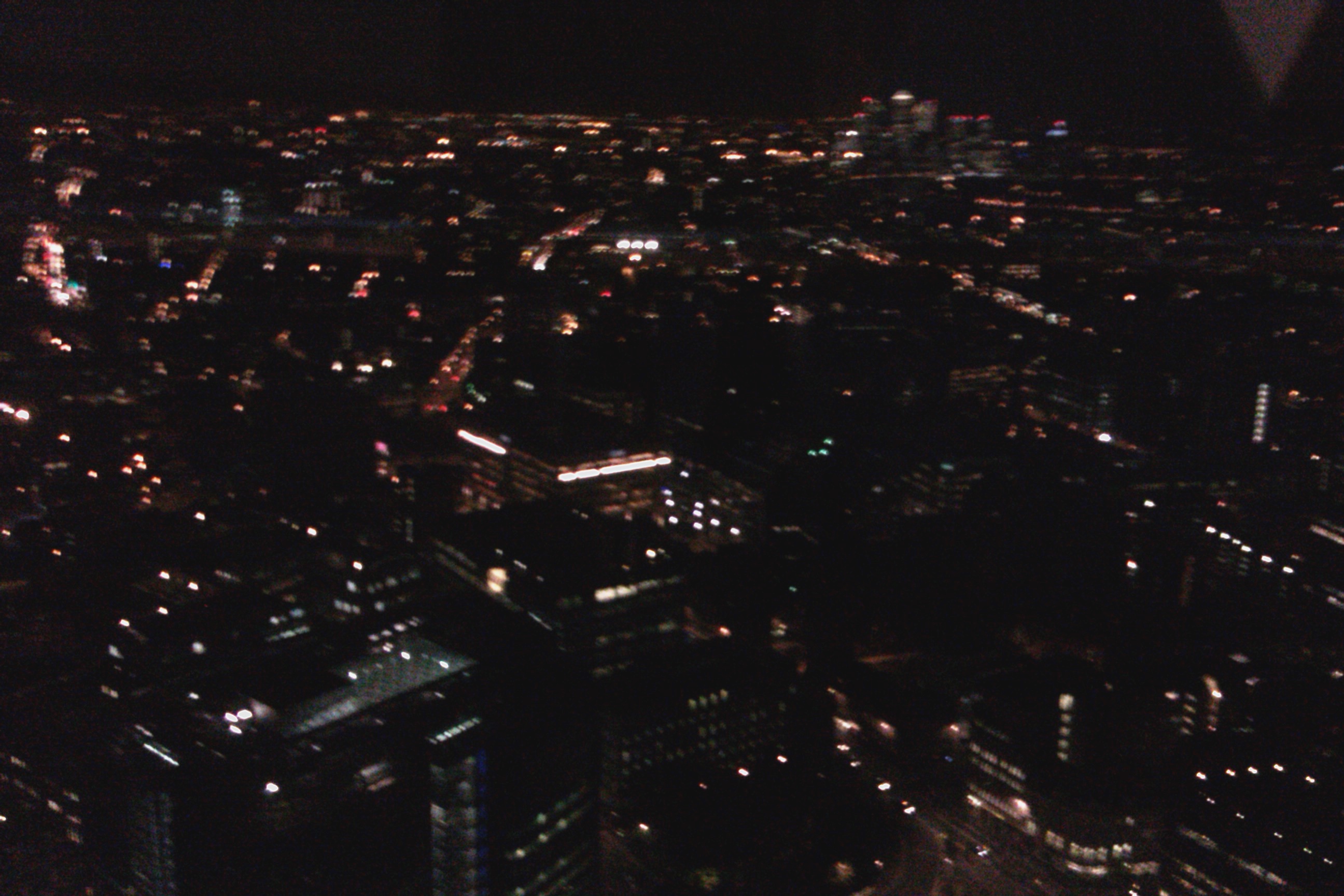
You will start to appreciate the lengths I go to in order to keep you entertained when I tell you that in order to obtain this photo, I had to sit through a half-hour presentation on the benefits of buying land in Brazil.
The beloved, you see, had been offered a glass of champagne at the top of the Gherkin on condition that he undertake a mysterious assignment, the details of which would be revealed on the day. He was allowed to bring a friend, so on Friday evening we duly turned up at 30 St Mary Axe, instantly distinguishable from the floods of people who work there by our absent suits and ties, and awaited further instructions.
After a few minutes, we were guided through an airport security gate and through to the lifts, where we were sternly told not to take any photos. Then up to the twenty-somethingth floor, where we were offered tea or coffee and placed in a sanitary-looking waiting room with some other victims. “Do you know what we’re here for?”, they asked us, anxiously. “No”, we admitted, “but we think it’s safe.”
Eventually we were escorted next door to a room dotted with round tables, at each of which sat a lonely-looking salesperson. We were pointed towards Danny*, whose shiny suit almost disguised the fact that he was barely out of his teens. Danny told us that we’d be watching a short presentation about buying property in Brazil. We asked Danny some questions. Danny didn’t know the answers, but what he didn’t know he made up for by repeating sections from his practised sales spiel.
Then we watched a video, in which an American woman berated us for foolishly keeping all money in the bank (she clearly hadn’t seen our statements) and suggested that the only sensible option was to invest in property. She then explained that it was best to do this in “developing” countries, where land was cheaper and ripe for development.
They stopped the video and asked for questions. The beloved tried to ask about sustainable development and artificial inflation of land prices. I tried to ask about the protection of wildlife. Danny still didn’t know the answers, but gamely filled in the space with more rehearsed lines. He put me in mind of an estate agent, which I suppose is what he was. We watched some more of the video. We decided not to ask any more questions.
If Danny’s sales method was uncompromising, it was as nothing compared to the full-force blast of hot air we got from his boss, who looked like a genuine 1980s car salesman with a checked suit and dyed blond hair and treated us to a full minute of his undivided attention. Any more and we’d probably have given in and remortgaged the egg to buy the land, but fortunately he somehow divined our lack of engagement with the process and left us alone with Danny, who, sensing that his chance had gone, suggested we retire upstairs for the glass of champagne.
Several complicated lift journeys later, we reached the 38th floor, on which lurks a private members’ bar, where we sat and admired the view while Danny ordered the champagne. And suddenly, as we sat and chatted, a small miracle started to happen. It began with a conversation about where we lived, which gradually expanded to cover Danny’s friend’s band, his thoughts on the beloved’s jacket and, eventually, his preference for films about revolutionaries (“I’m not really bothered about the politics, I just really love a rebel”). This corporate robot had quietly turned into a real person, who smiled for the first time as his infectious enthusiasm gradually brought a sparkle to the evening, as well as the wine.
We shan’t be buying any land in Brazil, but when I think about Friday night, I am most pleased not by the terrific view or the adequate champagne, but by the sight of someone slipping out of corporate mode and into human mode in front of my eyes. I imagine his company would sell more property if they allowed their employees to be humans the whole time, rather than only when they fail to make a sale. And just think what a nicer place the world would be if all companies adopted that strategy, rather than having their robots lie to us all the time. Ah well. It was nice to see it once.
*Names have been changed to protect the guilty
The printer in my office is making a funny noise this morning. Closer inspection reveals the following error message:

I’m not quite sure what to do about it.
Via David Schneider comes this extraordinary collection of potentially fatal encounters averted at the last minute:
It’s thrilling to see the speed at which people can react when threatened with sudden danger, and how calm they can be whilst making a split-second life or death decision.
(Less edifying are the nutters who throw themselves out of the paths of oncoming trains, apparently for fun. Bad enough for their families; even worse – and unforgivable, whatever the outcome – for the poor train drivers.)
I’ve just read a book of stories by H. P. Lovecraft, because his was the first name that came back when I took the I Write Like test, and because I am generally in favour of well-written horror stories.
Well, I’m not sure that these are either of those things. The writing’s not bad, exactly, but it’s fairly impenetrable in places. I’ve chosen an extreme example, but I have limited patience for paragraphs like this, from The Lurking Fear (unedited; ellipses his):
Shrieking, slithering, torrential shadows of red viscous madness chasing one another through endless, ensanguined condors of purple fulgurous sky… formless phantasms and kaleidoscopic mutations of a ghoulish, remembered scene; forests of monstrous over-nourished oaks with serpent roots twisting and sucking unnamable juices from an earth verminous with millions of cannibal devils; mound-like tentacles groping from underground nuclei of polypous perversion… insane lightning over malignant ivied walls and demon arcades choked with fungous vegetation…
I mean, what?
Where the stories work best is where there’s less fervid description and something is actually happening. The Dunwich Horror is really good up until the moment when the genuinely frightening half-human creature quietly disappears, at which point it becomes too abstract to retain my interest.
Maybe this is my fault: maybe I don’t have a brain that’s equipped to loosen itself from the bounds of mundane experience and appreciate a fantasy world where nothing bears any relation to anything. But these stories are fantasy, or maybe science fiction, not horror. To my mind, real horror arises from the creeping realisation that something that feels familiar is not what it seems. There are writers who can rouse me to night-time terrors – Mary Shelley, Stephen King, Edgar Allen Poe – but for me there’s not enough of real life in Lovecraft’s stories to make them truly frightening.
That said, the guy himself is pretty frickin’ scary:

So that’s something.
I’ve had this song in my head for a week. We used to sing it around the campfire at the Russian church camps I went to as a teenager, and I loved the words, which are a mixture of obvious Christian references (“ten for the ten commandments”) and lines so obscure that nobody has ever worked out what they mean (“two, two, the lilywhite boys, clothèd all in green ho ho”).
It’s also terrific fun to sing, and can last the full length of a shower or even quite a hefty round of washing up. This video gives you the guitar chords for added activity value.
NB: he has some of the words wrong. In addition to the lilywhite boys, who in his version are “all dressed up” in green ho ho (much less poetic), he seems to sing “five for the simples at your door”, which is charming but incorrect. It’s symbols. Here are the complete lyrics, should you want to sing along (this is just the last verse, but you can extrapolate):
I’ll sing you twelve ho
Green grow the rushes ho
What is your twelve ho?
Twelve for the twelve apostles
Eleven for the eleven that went to heaven
And ten for the ten commandments
Nine for the nine bright shiners
And eight for the April rainers
Seven for the seven stars in the sky
And six for the six proud walkers
Five for the symbols at your door
And four for the gospel makers
Three, three, the rivals
Two, two, the lilywhite boys, clothèd all in green ho ho
One is one and all alone and ever more shall be so
Exactly one year ago, I was here:
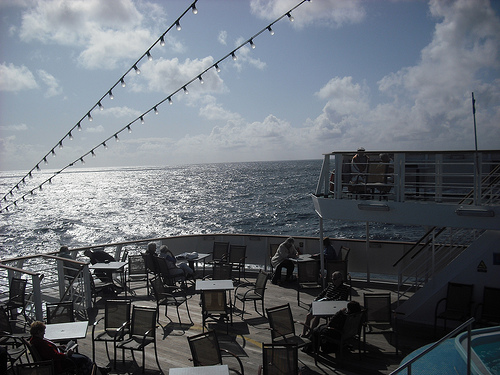
I know this because today is my birthday. I turned 33 on the high seas, and I am turning 34 a day after arriving back from a completely gorgeous trip to Ontario, spent with family old and new as well as some good books and better friends. Due to a lack of planning, the photos are lurking somewhere in my dad’s luggage, but they will make an appearance here and elsewhere soon.
Anyway, it turns out going on holiday around my birthday is a good thing to do, partly because it’s a treat and partly because when people ask me what I’m doing for my birthday I can say “going to Canada”, and thus be relieved of the obligation to hold any kind of a party. I like parties, but I like them best when they’re someone else’s.
The only downside of being away at this time of year is that I miss the start of the football season (do you see how carefully I chose the title of this post?). We started off in fine form with wins against Leicester City in the league and Yeovil in the Cup, then folllowed up with consecutive losses to Barnsley and Ipswich. We usually draw the opening game of the season, but is otherwise a fairly traditional start for us. However, I was cheered by the news (texted to me while I was away, its importance clearly warranting the cost of an international SMS) that Edgar Davids has signed to the club on a pay-per-play basis. That can only be fun.
Anyway, it’s about time for me to go back to bed so that I can shortly be brought breakfast in it. I used to dislike having a birthday at this time of year, because the season is just starting to turn, so my birthday always felt like the end of something. But in recent years I’ve come to realise that the end of summer is also the start of autumn, and autumn has a loveliness of its own. So I’ll take pleasure in today’s grey drizzle and look forward to the leaves changing colour. After all, when that happens, it means it’s nearly Christmas.
I think I need a new gadget. At the moment, I carry around:
What I want instead of all of those is something which
An iPhone is nearly the answer, but I don’t much like iPhones. I don’t mind getting two gadgets, as long as they both work, so maybe I need an Android phone and a separate music player and ebook reader. Would that work? Or maybe I need to make an Android phone work with iTunes, and then I can get a dedicated ebook reader. But is it worth getting an ebook reader now, before the market has settled down? I don’t want to end up with the Betamax of ebook readers.
Also, whatever I get must be small, and pretty.
Hmm.
 Glad All Over