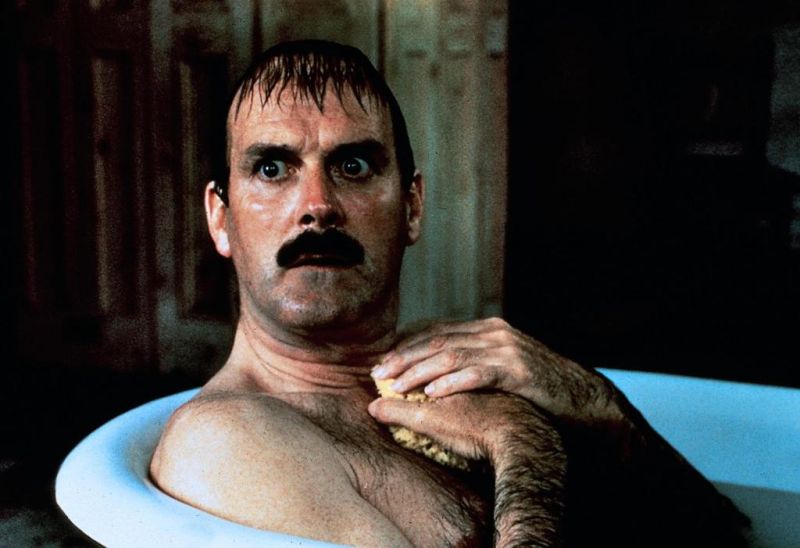
Bath rant

John Cleese in Clockwise
There is almost no situation in which this picture isn’t appropriate

I had a bath this morning, which is very unusual on a weekday but I was cold and aching from running in the rain a couple of evenings before, and – well, frankly, I wasn’t ready to be vertical.

Having a bath meant I listened to the Today programme, which most mornings I don’t any more, and listening to the Today programme reminded me why I don’t any more. I can’t have listened for more than 15 minutes but in that time it made me feel quite separately cross about three things, and I came out of the bath less relaxed than I’d gone in, which is all wrong. So to make me feel better, I’m going to make you cross about them too.

NUMBER ONE. John Humphrys exclaiming that nobody in authority had shouldered the blame for the child sex abuse gang uncovered in Rotherham last year. Nobody, that is, apart from the PERPETRATORS WHO WENT TO JAIL. I can’t bear the journalistic tendency to assume that when vulnerable people are harmed, it’s social services’ fault, as though the social care system isn’t full of desperately overworked and underfunded people trying as hard as they possibly can to stop people from coming to harm. Do the job yourself, Humphrys, and live on a social worker’s salary for a year, then start blaming them for organised criminal activity.

NUMBER TWO. David Cameron, on Letterman last night, was asked what “Magna Carta” meant, and apparently didn’t know the answer. Now, I didn’t know the answer either, but I know what Magna Carta is, and I speak English which means I can understand some Latin, so I was able to work it out. If I can do it, bloody David Cameron should be able to. I knew he was stupid, but I didn’t think he was stupid.

NUMBER THREE. A piece on Jamie Oliver’s new 15-minute dinners book, in which the nonsense argument was made for the sake of controversy where none existed (this technique will be  familiar to regular listeners) that the target audience for the book was owners of Jamie’s earlier 30-minute dinners book, and good grief, were we really so desperate for time that we needed to claw back another fifteen minutes in the evening, and what was wrong with spending an extra quarter of an hour doing something useful and enjoyable like cooking? Somebody (I have no idea who was being interviewed about it, except that none of them was Jamie Oliver) tried to make the OBVIOUS POINT that the book is aimed at people who don’t cook at all, and not at people who already enjoy cooking, but this was shouted down in the general frenzy.

I think tomorrow I shall return to comforting silence.

 

Period Pains

keira knightley

Do you watch a lot of period drama? I don’t, generally, but as it happens I have watched several hours’ worth this weekend, and I have noticed that there is a way people talk in (most) period drama which has nothing to do with the script: a mannered, diffident style which seems to transcend both character and chronology, so that it doesn’t matter if it’s rural Edwardian England (hello, The Woman In Black!) or 1950s London (howdy, Call The Midwife!) or – well, frankly, I have no real idea when Upstairs Downstairs, currently playing at a screen near me, is set, nor where, but everyone is speaking that way.

It wasn’t always like this. Nobody speaks that way in Room With A View, nor even in the 1990s TV adaptation of Pride and Prejudice. It seems to have sprung up since the early 2000s, which leads me to suspect it’s probably mostly Keira Knightley’s fault.

Sherlock

If you don’t like a TV programme, you should probably stop watching after the first episode, rather than keep watching and getting a bit crosser each time. Although, actually, I quite liked the first episode of Sherlock. It was the second, startlingly racist, episode that put me off, but somehow I kept watching, even when the third episode was unsatisfying and then we had to wait a year for number four. I can’t really explain it, except that I kept hoping it would get better.

And it wasn’t awful. There was lots to like about it: the casting is uniformly excellent and everybody does the best they can with the script. It looks good, and it sounds good, and it makes London look better than it does in real life.

But ugh, it’s so pleased with itself! The joy of the Conan Doyle stories comes from how clever Sherlock Holmes is, not how clever Arthur Conan Doyle is. It’s a small, but important, distinction. Sherlock is delighted by itself more than it is by the character, which makes it feel all wrong. I don’t want to be able to hear the programme-maker breathing down the back of my neck when I watch a drama, and watching this show I can feel him looming sweatily over me throughout.

(I’m not talking about anyone in particular here, but he is definitely a “he”. Drama on British TV is currently in the grip of a chummy group of clever-clever, white, middle-class men who are all jolly pleased with themselves and each other for being smarter than normal people. Unfortunately they are all quite good at making TV, damn them, but that doesn’t mean I have to like them.)

The problem the programme has, when it gets very overexcited about being clever, is twofold. Firstly, it loses sight of the beautiful simplicity that sits at the heart of the best Holmes stories. This show has more plot in ten minutes than an entire Conan Doyle novel. Secondly, if you’re going to be self-consciously clever, you’d better make sure that you are, in fact, being clever, and this is where Sherlock falls down for me. Quite apart from the dangling plot points and the baffling improbabilities, which flit by so fast that you can mostly ignore them, the show is terrifically excited about Technology, which somebody somewhere in the bowels of the BBC has clearly decided is going to be used as a Metaphor. The problem is, they haven’t bothered to get anyone with an actual grasp of the technology they’re talking about to act as an advisor on the show, with the result that we, the audience, are expected to be delighted by Feats of Technology which in real life are either ridiculously unimpressive or so improbable and unexplained as to be plain silly. Just as The Archers needs an agricultural story editor, Sherlock could have done with a technology advisor. And somebody should have sacked whoever decided to give Watson a “blog”. I put it in inverted commas because so do they, every time they mention it.

But that’s all nit-picking. What I really object to is the idea that the source material needs to be improved upon, when (a) it doesn’t, and (b) whatever description you might want to give of Sherlock, an improvement on the original is not it. At one point, during the entirely nonsensical denouement of last night’s show, Moriarty (wince-inducingly described in BBC1’s preamble as “Holmes’s ultimate nemesis”, as though you can have grades of nemesis) said to Holmes: “…that’s your weakness, you always want everything to be clever”. And I thought: you got it in one.

(I had a separate rant last night at the TV and the beloved about what they did with Moriarty, but since it included the words “postmodern” and “non-linear” I shan’t repeat it here, or we’ll both go away thinking I’m the most terrible kind of wanker.)

Friday night dinner at Grandma’s house

I dunno. You wait ages for a post-watershed sitcom about a Jewish family starring a well-known Simon, then two come along at once.

In case you haven’t seen them, the two sitcoms in question are Grandma’s House, starring non-actor Simon Amstell, which went out towards the end of last year; and Friday Night Dinner, starring, frankly, non-actor Simon Bird, which started this weekend. I liked Grandma’s House a lot; nothing ever really happened, but it made me laugh, and its matter-of-factness felt real, even though the characters were caricatures. And everyone except Simon Amstell could act, and Simon Amstell not being able to act was sort of part of the joke, so it was OK.

And I liked Friday Night Dinner, too. It had more proper laughs than Grandma’s House, and the wonderful Mark Heap who is such a brilliant physical clown that I could just watch him moving around silently for half an hour. And Simon Bird plays his likeable self, which is just as well. Had I seen it without seeing Grandma’s House, I would have given it a resounding thumbs up, if gestures can resound, which I suspect they can’t.

But they are really, really startlingly similar! The characters in Grandma’s House may be more overdone than in Friday Night Dinner, but they are, fundamentally, the same characters. There is a Simon (although he’s called Adam in Friday Night Dinner); his irritating younger relative (Jamal Hadjkura in Grandma’s House and Tom Rosenthal in Friday Night Dinner); the married couple whose house it all happens in, who are fond of one another deep down but can’t help squabbling (Geoffrey Hutchings and Linda Bassett/Paul Ritter and Tamsin Greig); the overbearing and dowdy Jewish mother whose main occupation is nagging at the rest of her family (Rebecca Front and Samantha Spiro both play this character in Grandma’s House; in Friday Night Dinner it’s still Tamsin Greig), and the weird outsider who turns up halfway through each episode and unsettles everybody (James Smith/Mark Heap).

Coincidentally, in each case the overbearing mother and the weird outsider have also jointly starred in an earlier sitcom (The Thick Of It and The Green Room, respectively), but that really must be down to chance. Well, of course it’s all down to chance – the creators of Friday Night Supper must have had their scripts complete and ready to go, if not filmed, by the time Grandma’s House aired – but the two are so very alike that I almost wonder why, having seen Grandma’s House, they didn’t go back and rewrite.

But I’m not really complaining; as I said, I am delighted to be able to watch a Jewish sitcom that isn’t Seinfeld, and I like both programmes a lot (although I’ll like them even better if they manage to introduce a comedy Jewish woman who doesn’t look like a 1970s Geography teacher). And anyway, there’s only been one episode of Friday Night Dinner, so it’s a bit early to judge. If episode six is set on an aircraft carrier and Simon is fighting Godzilla, I promise I’ll eat my words.

Trousers

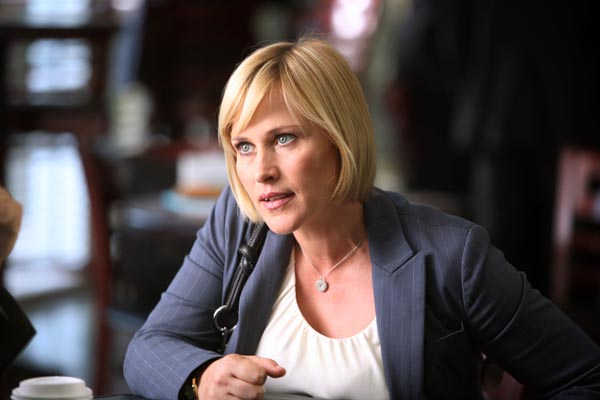
I bought two pairs of trousers this week. I don’t very often wear trousers, but I was inspired by this article by Jess Cartner-Morley, the only fashion writer whose advice it’s actually possible to follow, and by Patricia Arquette’s character in Medium, Allison Dubois, who is my office-wear muse because she always looks effortlessly elegant even though she hardly ever gets any sleep and saves someone’s life nearly every week. And she almost always wears trousers. Of course, there isn’t a single photo on the internet where you can see her bottom half, so you’ll just have to take my word for it:

Patricia Arquette as Allison Dubois

So I bought some trousers. I’ve just remembered that the other reason was because last weekend I bought this top in the Dust sale:

Brown cowl-neck top(It looks really drab on the internet, doesn’t it? It’s nicer in real life)

And I thought I needed some trousers to go with it. Trousers or a pencil skirt, but I am even less a pencil skirt wearer than I am a trouser wearer.

So trousers it was. I bought a brownish pair, which goes with the top and anything vaguely warm-toned, and a greyish pair, which I am wearing today with a pale grey polo-neck vest and a grey striped sleeveless shirt. I am a vision of colourlessness.

Anyway, I like the trousers. They are flattering and comfortable and they broaden my work wardrobe by a much higher factor than the simple addition of two new items of clothing. HOWEVER, who designed the fastenings on smart trousers? Both pairs have

  • A button
  • Three hook fastenings
  • A zip
  • A belt

Are work trousers more inclined than most to fall down inopportunely? Or is it just that it’s more embarrassing if your trousers fall down at work than if it happens elsewhere, when you would just laugh it off? I cannot imagine circumstances in which a zip and a belt, or some buttons and a belt, wouldn’t have sufficed.

That aside, I am enjoying my new status as a trouser-wearer. But I still don’t know why anyone would wear them for fun.

QI

I like QI. I like Stephen Fry, and I like Alan Davies – or at least, I like the version of Alan Davies that appears in QI – and I like the format. I like most of the guests, with honourable exceptions for Jeremy Clarkson and Rory McGrath. I especially like Rich Hall. And I like it when they get slightly unexpected people in for a one-off. After all, the only qualifications for being on QI are that you are (a) fairly well-known and (b) not stupid. Right?

Well, sort of. The problem is that using those criteria you might expect to end up with a roughly equal gender split, and QI has never had that. I have just, because I am a serious and dedicated blogger, had a look at the complete guest list for every episode ever of QI, and I have discovered, to my disappointment but not to my surprise, that there has only ever been one episode broadcast which featured more than one female guest, and that that episode was one in series D whose subject matter was “Domesticity”. Ahem.

I know all the arguments about why there are more male than female comics. I even agree with some of them, like the one about the level of competitive blokery prevalent on the club circuit, which is where most comics start from. But QI isn’t limited to comedians. It has featured DJs:

danny baker

composers:

Howard Goodall

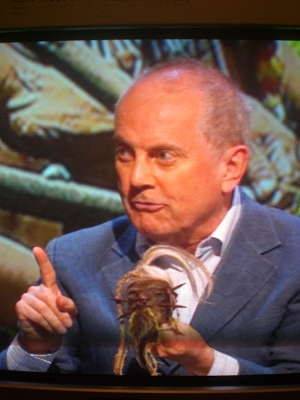
politicians:

Gyles Brandreth

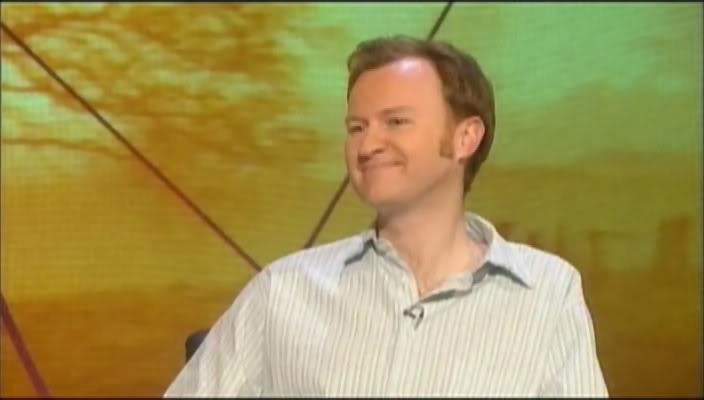
and writers:

Mark Gatiss

…as well as countless actors and presenters. You could describe these people as wits, but they’re not comedians. And there are plenty of bright, witty women around. Some of them are even comedians. I’m pleased to see Sandi Toksvig and Sue Perkins cropping up more frequently in recent series, and I would happily watch Jo Brand every week, but if Daniel Radcliffe can be invited on, where are Josie Long, Victoria Coren, Mariella Frostrup, Shappi Khorsandi, Miranda Hart, Sally Phillips, Lucy Porter, Sarah Millican, Julia Davis and Tamsin Greig? Where, for that matter (if you’re going to have John Sessions and Rory Bremner), are Dawn French, Jennifer Saunders, Joanna Lumley, Victoria Wood, Alison Steadman, Caroline Quentin and Patricia Routledge?

I can only assume that they’re scared that an all-female panel, or even a mostly-female panel, will be cleverer and funnier than the men-only shows. I have a sneaking suspicion that they’re right.

For a week or two

I am going on holiday tomorrow. To here:

Last night, I dreamed that it was tomorrow morning, and I’d forgotten to print the boarding passes before leaving work. Then I realised, in my dream, that we were flying from King’s Cross, which meant we could print everything at the beloved’s nearby workplace, so it was all alright. Then the alarm went, and I realised we’re not flying from King’s Cross (I think you have to have special permission to fly anything out of N1) but from Gatwick. Shit, I thought: we won’t be able to print the tickets and now we can’t go on holiday. It took a couple of minutes’ early morning panicking before I realised it was still Monday, so I hadn’t missed my chance after all.

I think I really, really need this holiday.

That aside, this Monday morning was better than most, partly because today is my last day at work for a bit and partly because I had accidentally left the radio on Magic FM, which I’d turned over to on Saturday when I was feeling exuberant and in need of something to sing along to. Being woken up by Islands In The Stream is one hundred times less stressful than having to listen to John Humphrys being unnecessarily aggressive at half past seven in the morning. But if I don’t listen to Today, what will I blog about? One to ponder from that terrace over the next few days.

Air rage

When we awoke on Thursday morning to the news that flights across northern Europe had been grounded because of a cloud of ash from an erupting  Icelandic volcano, nobody was quite sure what to think. It was inconvenient, certainly, but it was also kind of exciting. Invisible volcanic ash in the sky!

For a couple of days, the radio news switched between election stories and volcano stories, and somebody (I thought it was Jon Snow on Twitter, but I can’t find a reference) pointed out how unusual it was for a news story this big to have nothing to do with any human agency; with nobody knowing or able to affect what would happen next. There were mutterings about the might of mother nature.

Then, yesterday, broadcasters got bored of talking about nature and decided they needed somebody to blame. A representative from an airline was invited on to the radio to explain that his colleagues had been running test flights all weekend, and the planes had been coming back unharmed. A presenter on the Today programme (I was a bit asleep, so I’m not sure who, sorry) crossly asked Lord Adonis (the transport secretary, not a classical superhero) why UK airspace wasn’t open yet, if it was safe to fly. Lord Adonis explained that the Met Office’s test flights, identical to the airlines’ except that they had instruments with which to measure the density and distribution of volcanic ash in the atmosphere, showed that it was not yet safe to send planes up. This morning, the programme was asking whether the government had mishandled events and acted too hastily in banning all flights.

Well, I don’t know about you, but I’d rather be stranded than dead. Air travel is one of the areas in which it’s never ever OK not to err on the side of caution, and were flights to be allowed in and out of the UK sooner than expected, the same sniping presenters and pressmen would have been asking whether the government had acted too hastily in allowing flights and putting travellers’ safety at risk.

So they can’t win. And I am once again faintly depressed by the press’s need to automatically challenge every decision the authorities make, just for the sake of it. Challenge political decisions by all means, or at least ask for them to be explained. But nobody has acted with anything other than good and honest intentions here. The various meteorologists, engineers and elected representatives whose responsibility it is to come up with a plan have been in constant discussions since this thing started, and personally I am happy to assume that (a) they know their jobs better than I do, and (b) none of them has a vested interest in wrecking the livelihoods of airline workers or in sending unwitting air passengers on flights of doom.

Unfortunately the Today programme isn’t designed to give us information so much as to create controversy where none exists, so this story has become a fight when it didn’t need to.

Of course, there are thousands of people undergoing inconvenience and expense because they’re stuck somewhere they don’t want to be, and the effect on some businesses is potentially huge, and there are people missing weddings and funerals, and maybe not getting home in time to see someone before they die. It’s not any fun. But although as individuals we feel a sense of injustice when bad things happen to us for no reason, as a society we need to be able to see that there is no reason, rather than desperately seeking a scapegoat. And the press, especially the publicly funded and accountable BBC, has a duty not to succumb to hysteria, but to take a measured view of what the situation actually is.

On a more selfish note, I find myself entranced by the sight of a London sky without vapour trails. As it happens we are having an unusually clear and dry April, so the effect is even more pronounced. The sky above Brixton has never looked like this in my lifetime, and it probably never will again:

(Sorry for slightly crappy photo, it was taken with my slightly crappy phone.)

Early morning rage

I think I need a new radio station to listen to first thing in the morning. On the days when I leap out of bed like the lark it’s not so bad, because I only get to hear the weather forecast, which is all I really need. But on the days when it takes me a little longer to emerge, blinking, from under the duvet, the Today programme is capable of rousing me to a state of apoplexy that isn’t healthy before breakfast.

I have always been bemused by the programme’s apparent remit to challenge everything their guests say, no matter how apparently uncontroversial. Fighting for the sake of a fight seems an unlikely position for a magazine show to take, although some presenters (I’m looking at you, Humphreys and Naughtie) are worse than others.

But a couple of times in the last week or two this stance seems to have tipped over into something a bit more disturbing. After the imprisonment of Metropolitan Police Commander Ali Dizaei earlier this month for misconduct in a public office and perverting the course of justice, John Humphrys interviewed Alfred John, current chairman of the Metropolitan Black Police Association, of which Dizaei was once president. Fair enough, except that a disproportionate amount of time was devoted to whether and to what extent the MBPA had been “discredited” by Dizaei’s conviction.

If a former police officer breaks the law, it’s the police service itself which is discredited (if anyone but the offender is), and not an association his membership of which had nothing to do with the crime for which he was convicted. What was really happening here was that Dizaei had rubbed a lot of people up the wrong way while at the helm of the MBPA, leading to a distrust of the association in some quarters, and this was a chance to smear it by insinuating that Dizaei’s criminal activity was somehow related to his insistence that the Metropolitan Police is still institutionally racist, when the two things are quite seperate. Just because he’s a criminal doesn’t mean he’s wrong about everything. Both Alfred John and the other guest, Brian Paddick, agreed that there is still racism within the police service, and that the MBPA has a legitimate and important job to do.

“Given that you have tried and failed by your own admission”, responded Humphrys, “there must surely be a better way of dealing with this.”

This was a novel twist. The MBPA should be disbanded not because there isn’t racism in the police, but because there is. Alfred John dealt with this silly challenge quickly and easily, but he shouldn’t have had to. I’m not sure that emphasising Dizaei’s relationship with the MBPA was the way to go at all in this feature, but the suggestion that there’s a problem with the existence of the association itself because of the actions of one officer, no matter how high-profile, makes me uncomfortable and I think reflects very badly on the programme and its editors.

Then a few days later the Church of England got into another one of its wrangles about gay members of the clergy. “It’s a moral question, isn’t it?”, opined James Naughtie. Well, Jim, not really. Not unless you actually think there’s still a question to be answered about whether it’s OK to be gay. If there isn’t, it’s if anything a legal question about whether the church is breaking employment law by discriminating against a particular group of people. You ridiculous man.

Which made me wonder, incidentally, why we don’t prosecute religious organisations which don’t allow certain groups to do particular jobs, or religious figures who incite hatred by speaking out against certain groups or individuals. Why can’t we ban the Pope from the UK unless he stops attacking equality legislation, or take him to court if he comes? I am fervently hoping Peter Tatchell will rise to the occasion, but he shouldn’t have to. We should oppose discrimination wherever we find it and not avoid confrontation at the risk of offending someone. The Pope is just a man.

So as you can see, I need something calming to wake up to. Birdsong, possibly, or classical music. If you have any suggestions, please let me know before I burst a blood vessel.