Advent song for December 4

Girls Aloud’s Sound of the Underground, in 2002, was the first reality TV Christmas number one. None of us realised then that Cowell would have the slot sewn up for most of the rest of the decade.

I like this song a lot, but I think the video is misjudged. It should have been cool and edgy, not slow-motion and faux-sexy, although faux-sexy seems to be what Girls Aloud mainly do, stylewise, which is a shame because if they weren’t forced into dressing like a teenage boy’s idea of a prostitute they would all be – they all are – properly sexy anyway. At least they all have their own hair in this video.

http://www.youtube.com/watch?v=OnLrNHCQPP0

Advent song for December 3

This was originally on the rejects pile, but the song I was going to have today isn’t on YouTube, except in a long and tedious version, so instead here’s Whitney, UK Christmas number one in 1992, when she was still insanely beautiful. I hope that whoever  cast Kevin Costner, the most insipid man in the world, as (a) a bodyguard and (b) Whitney Houston’s love interest has since found a job better suited to their talents.

This version cuts the song off a little before the end, but if you’re like me you’ll find you won’t mind that a bit. Perhaps you can use the spare time to listen to Dolly Parton’s superior version (just don’t read the comments underneath).

Advent song for December 2

2003 was a vintage year for Christmas songs. We were treated to Avid Merrion’s Proper Crimbo, which was fun, but which I now discover has a very long and mostly stupid video, and The Darkness’s Christmas Time (Don’t Let The Bells End), which was properly brilliant. And instead we chose to make Gary Jules’ melancholy and slightly drab version of Mad World our Christmas number one. The two reasons to be grateful for this are that (1) it gave us a mesmerisingly terrifying performance from the much-missed Aiden in this year’s X Factor, and (2) it’s given me a reason to check out the video, which is actually quite lovely:

(Also, just be pleased that the other two inhabitants of that week’s top five, Happy Christmas (War is Over) by the Pop Idols and Changes by Ozzy and Kelly Osbourne, missed out on the top slot.)

Advent song for December 1

I’ve been so busy with real life (about which more in the new year, I expect) that I’ve barely had a chance to post recently, so it’s with a sigh of relief that I realise it’s time to resurrect the annual Gladallover musical advent calendar. I’ve already used up all my favourite Christmas songs, so rather than resorting to all my least favourite Christmas songs, this year I’m introducing a theme. All the songs this year will be UK Christmas number ones from my lifetime, counting down in order from the 24th-best to the best. Since I have been alive for 34 Christmases I have dropped the ten worst, but I’m not going to tell you which they are until Christmas Eve, otherwise you’ll be able to work out what’s coming.

So without further preamble I present the UK Christmas number one from 1980, The St Winifred’s School Choir singing There’s No-One Quite Like Grandma. It’s pretty awful, but it’s sort of mesmerising at the same time. I was four that Christmas, which means these children are probably only a couple of years older than me. What strikes me, when I watch the video, is how completely of their time they look. You could date it to within a couple of years just by the haircuts. Good old the 1980s.

Battlespace: Unrealities of War

I’ve got lots of posts lined up which I’m intending to write sometime soon, but real life keeps getting in the way and now I’m in bed with flu and barely lucid enough to open up the laptop, let alone post. However, this one is time-specific so I’m doing it now before I forget: if you’re in or near London, this exhibition of war photos from Iraq and Afghanistan is full of startling pictures that you won’t see anywhere else, and is well worth paying a visit to.

Some of the photos are quite gory – but then, so is war. More distressing to me, though, were the ones showing the fear in the faces of civilians suddenly confronted by British or American soldiers. We’ll never see photos like these in our mainstream media, because they make it clear that the relationships between ordinary people of the countries involved and our armed forces are difficult and painful, which makes it much harder to argue that we’re anywhere near winning “the battle for hearts and minds”. In fact, in these snippets from daily life we look more like a hostile invading force, which one might argue is exactly what we are. Chilling, heartbreaking and not for the squeamish, but absolutely worth seeing.

More details and info from Great Western Studios.

Holiday time

I’m accidentally got a Christmas head on me two months too early, having been to see a charming snowbound Norwegian film called Home For Christmas at the LFF this week, and it’s been exacerbated by my having just made the Christmas pudding. Now is about the right time to do it, but it puts me into the festive spirit too soon.

So I am remedying it with this summer song by Hildegard Knef, which raises my spirits in quite a different way. Enjoy.

Rough customer

I promised months ago that I’d write about the Rough Guide to Cyprus and why it’s no good at all, and then I forgot, and then I remembered but didn’t have the book to hand in order to quote it. But now I do, and flicking through it I discover I’m every bit as bemused by it as I was at the time.

It may be that Rough Guides are not designed for people like me, who just want to go on holiday. Here is a short quiz which will help you to determine whether you are the kind of person the Rough Guide to Cyprus might be aimed at:

Question 1

Do you look down on everyone else who has travelled to your holiday destination at the same time as you?

Question 2

Do you describe yourself as a traveller, rather than a tourist?

If you answered mostly YES, you may get on with The Rough Guide to Cyprus better than I did. I found it pompous, snobbish, humourless and ill-conceived. I first noticed this when I was reading the section about Cypriot cuisine. It says:

Food throughout Cyprus is generally hearty rather than refined, and on the mainstream tourist circuit at least will get monotonous after a few days. In many respects resort food – especially in the South – is the unfortunate offspring of generic Middle Eastern, and 1960s British, cooking at its least imaginative.

Well, that’s simple enough – just don’t eat at any “resorts”, “especially in the South”. Got that? Never mind that people have varied tastes and palates (personally, I like “generic Middle Eastern” food more than almost any other kind). Never mind that even smallish Cypriot towns on the “mainstream tourist circuit” offer a range of international cuisine as wide as anything you’d find in an English town of twice the size. No, Cypriot food in any of the places you’re actually likely to be staying (there’s a reason it’s called the tourist circuit)  is monotonous and unimaginative.

(There’s a lot of this guff about the “mainstream tourist circuit”, incidentally. The writers don’t seem keen on your visiting any of the places on which Cyprus’s economy depends for a substantial part of its income, preferring to recommend remote spots which you have  to drive to, environmental considerations clearly playing second fiddle to the traveller’s desire for an authentic experience, whatever that is.)

It was in Cyprus that I first tasted halloumi, which is one of my favourite foods in the world. Surely, I thought, they can’t be rude about halloumi. Everyone like halloumi.

Unfortunately, inferior rubber halloumi – full of added yeast and powdered (cow) milk, squeaking on the teeth when chewed – abounds; when you finally get the real thing (from sheep or goat milk, with the butterfat oozing out at the touch of a fork), you’ll never willingly go back to the other.

Well, I have eaten more halloumi, in Cyprus and elsewhere, than anyone I know, and I think that’s bollocks. Sure, the cheap stuff is squeakier, but it’s still terrific.

(And yes, the writing is all like that.)

We were staying between Paphos and Coral Bay, so I had a look at the restaurant listings for both places to see whether I could find any recommendations I liked the sound of. It only listed a few places, but one caught my eye:

La Piazza: Very upmarket Italian with a Venetian flair, its menus and recipes vetted once yearly by a North Italian professor.

A what now?  This bizarre detail struck me much as those adverts do that begin with a confident, and meaningless, “Scientists say…”. No extra information was given, and I should have asked when we ate at what turned out to be a fairly average but perfectly pleasant Italian, but I forgot. If you go and find out, do please let me know.

The best thing about La Piazza is not the food but the view, which looks like this:
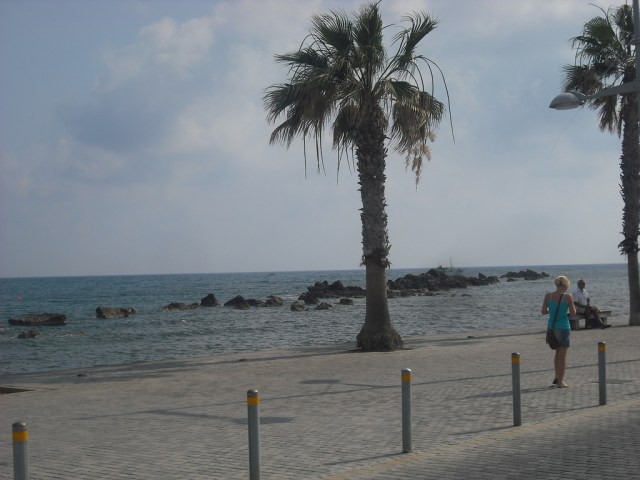
beach view

The writers of The Rough Guide to Cyprus clearly don’t have much time for this view, though, because if you look up what to do in Paphos, it says:

The main resort strip in Kato Pafos, east of Apostolou Pavlou and the harbour, consists of opticians, estate agents, ice-cream parlours, fast-food franchises, more estate agents, indistinguishable restaurants, nightclubs, still more estate agents, clothes shops, souvenir kiosks, banks and excursion agencies, the characterless pattern repeating itself every couple of hundred yards along Leoforos Posidhonos, the shoreline boulevard. The only “sight” on this lacklustre sequence is the Paphos Aquarium…

Well, that’s more or less true, but as an introductory paragraph to a section on what to see in Paphos, it leaves something to be desired. I’d have started it like this:

The main resort strip in Kato Pafos, east of Apostolou Pavlou and the harbour, has all the shops you need to stock up on provisions for your holiday, as well as an abundance of places to stop to eat, drink and enjoy the view of the harbour. There are also plentiful tourist agencies where you’ll be able to book trips to the more inacessible parts of the island, but don’t forget to spend some time sitting still and absorbing the busy, bustling atmosphere and headily international population of this cheerful tourist town.

And if you can describe an aquarium as “the only sight” in a place this lively and friendly, you have a very narrow view of what counts as a sight, and you probably won’t enjoy your holiday at all. Incidentally, that line of stones stretching out into the sea in the photo above is an ancient breakwater.

Coral Bay, a few miles up the coast and much smaller than Paphos but with the advantage of a glorious sandy beach, is a genuine single-duty tourist town and much less varied, but it does have a lot of restaurants. What did the Guide have to say about them?

Restaurants on the main strip are generally pretty forgettable; much the best local eating is at the South-Indian-run Keralam, northwest of the main beach in the Aristo Coral Bay complex.

Right. Because us Brits don’t get the chance to eat good Indian food at home.

(Here, as an aside, are my two recommendations for places to eat. In Coral Bay, Phideas Tavern (which I can’t find on the web but which you’ll find easily enough once you get there) looks like a canteen but does fantastic traditional Cypriot food for almost no money at all, and you get to spend the evening with Phideas himself, who is great fun. I ate here in 2001 and again in 2010 and was charmed and delighted to find that it hadn’t changed at all.

And in Paphos, you absolutely must go to Seven St George, which does some of the best food I’ve ever eaten, and is one of the few places in the world where I’m happy to eat pork and lamb. Like Phideas, it’s run by a family, all of whom you’ll meet during the course of your visit, and what George lacks in cheeky banter he makes up for with a beguilingly serious dedication to good food. There’s no menu at Seven St George: they just bring you meze dishes until you’re full. Everything is tiny, beautiful and delicious, and you’ll have eaten your own body weight before you notice it. Seating is outside on a flower-covered terrace, and dinner there is like sneaking three hours in heaven.)

Writing about Phideas and George has lifted my mood and almost made me forgive the writers of the Rough Guide to Cyprus their snobbery, except that as a final insult, the glossary of useful Greek and Turkish words doesn’t include the word for “cheers”, which I’ve found is the most important word to know if you, like me, like to meet people and talk to them when you visit other countries, rather than sniffily disapproving of the tourism industry that keeps most of them in work.

So as my final gift to you today, cheers is “yiamas” in south Cyprus and “şerefe” in the north, and if you go, you’ll have plenty of chances to use them both.

Lovecraft

I’ve just read a book of stories by H. P. Lovecraft, because his was the first name that came back when I took the I Write Like test, and because I am generally in favour of well-written horror stories.

Well, I’m not sure that these are either of those things. The writing’s not bad, exactly, but it’s fairly impenetrable in places. I’ve chosen an extreme example, but I have limited patience for paragraphs like this, from The Lurking Fear (unedited; ellipses his):

Shrieking, slithering, torrential shadows of red viscous madness chasing one another through endless, ensanguined condors of purple fulgurous sky… formless phantasms and kaleidoscopic mutations of a ghoulish, remembered scene; forests of monstrous over-nourished oaks with serpent roots twisting and sucking unnamable juices from an earth verminous with millions of cannibal devils; mound-like tentacles groping from underground nuclei of polypous perversion… insane lightning over malignant ivied walls and demon arcades choked with fungous vegetation…

I mean, what?

Where the stories work best is where there’s less fervid description and something is actually happening. The Dunwich Horror is really good up until the moment when the genuinely frightening half-human creature quietly disappears, at which point it becomes too abstract to retain my interest.

Maybe this is my fault: maybe I don’t have a brain that’s equipped to loosen itself from the bounds of mundane experience and appreciate a fantasy world where nothing bears any relation to anything. But these stories are fantasy, or maybe science fiction, not horror. To my mind, real horror arises from the creeping realisation that something that feels familiar is not what it seems. There are writers who can rouse me to night-time terrors – Mary Shelley, Stephen King, Edgar Allen Poe – but for me there’s not enough of real life in Lovecraft’s stories to make them truly frightening.

That said, the guy himself is pretty frickin’ scary:

H P Lovecraft and cat

So that’s something.

Green Grow the Rushes

I’ve had this song in my head for a week. We used to sing it around the campfire at the Russian church camps I went to as a teenager, and I loved the words, which are a mixture of obvious Christian references (“ten for the ten commandments”) and lines so obscure that nobody has ever worked out what they mean (“two, two, the lilywhite boys, clothèd all in green ho ho”).

It’s also terrific fun to sing, and can last the full length of a shower or even quite a hefty round of washing up. This video gives you the guitar chords for added activity value.

NB: he has some of the words wrong. In addition to the lilywhite boys, who in his version are “all dressed up” in green ho ho (much less poetic), he seems to sing “five for the simples at your door”, which is charming but incorrect. It’s symbols. Here are the complete lyrics, should you want to sing along (this is just the last verse, but you can extrapolate):

I’ll sing you twelve ho

Green grow the rushes ho

What is your twelve ho?

Twelve for the twelve apostles

Eleven for the eleven that went to heaven

And ten for the ten commandments

Nine for the nine bright shiners

And eight for the April rainers

Seven for the seven stars in the sky

And six for the six proud walkers

Five for the symbols at your door

And four for the gospel makers

Three, three, the rivals

Two, two, the lilywhite boys, clothèd all in green ho ho

One is one and all alone and ever more shall be so