Comic Relief

You know what? I unashamedly and unironically love Red Nose DayLove it. I love Jonathan Ross being a bit rude (but not very), and I love it when the casts of Eastenders and The Bill do a comedy routine, and I love it when the cast of West End musicals bomb across town to Television Centre after their curtain call and perform all over again for the cameras.

I even love Lenny Henry, which I understand is very much not the thing these days.  But I do, and if I lived in Yorkshire I’d have gone to see him in Othello.

So come tomorrow evening you won’t find me at either of my siblings’ gigs (which saves me from having to choose a favourite, which is lucky), but curled up in front of the TV getting overexcited before the spectacle even begins.

Olympics site

I forgot to mention an inadvertent bit of tourism which I did on the way to Norfolk: at Stratford station we spotted what can only have been the 2012 Olympic village.  It’s in the very early stages of being built, but the scale of it is awesome already. If you can find an excuse for going to Stratford, go there sooner rather than later.

I went to Norfolk, but it was shut

My beloved and I spent three nights at the Victoria Hotel in Holkham, on the north Norfolk coast, last week. It’s a beautiful part of the world and a little like visiting the 1950s. Church doors are left open so the curious passer-by can wander in and have a look around; there’s a red pillar box and an old-fashioned phonebox on every village green – and, best of all, there are free, clean public lavatories which are abundantly possessed of soap and hand towels. It was all so civilised I didn’t know where to look.

They do like to close things for the winter,  but although Holkham Hall itself only opens to visitors during the summer, we were looking forward to exploring the grounds and perhaps meeting a deer or two. A sign told us to turn back barely a  minute up the drive, so we went back to the hotel where the receptionist helpfully rang up the Hall and was told that it was because they were “gassing moles”, which I imagine is the only time that has ever been used as an excuse for anything. I was so charmed I almost didn’t mind missing out on the park.

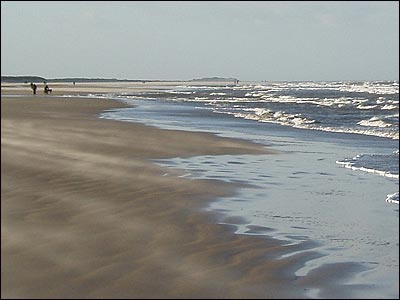
Slightly more disappointing was our failure to spot any seals on our seal-spotting excursion. We caught brief glimpses of a couple in the sea, but having been told by our ship’s captain (the most authentic Norfolker I have ever met) that there were “usually” six hundred of them sunbathing on the sand, we were hoping for more. I did get some pretty photos of the sea, though:

sea

I tried to warm to Norwich, but they need to move the station so that the eager visitor doesn’t have to walk a mile up an unlovely hill lined with takeaways to reach the city centre.  On the other hand, the shop assistant in Waterstone’s was very friendly indeed, so it wasn’t all bad.

I am now trying to plan a career move which would allow me to live in a cottage overlooking the sea.  I’d be happy in any of the towns along that stretch of coast, but I especially liked the look of Salthouse, Stiffkey (pronounced “Stewkey”, and you’ll be glad I warned you next time you visit) and Cley Next The Sea.  If you happen to have property for sale in any of those, do let me know.

Taipei 101 revisited

There was a programme on BBC2 this evening about Taipei 101, the counterweighted skyscraper I wrote about a few months ago.  If you can endure Richard Hammond (who, separated from the others, is fairly inoffensive, though I prefer the wild-haired one and have no time at all for Clarkson), it’s worth checking out on the iPlayer.  The show focuses on the various feats of engineering which went into the building’s construction, and I was pleased to discover that the story of the building is just as fascinating as the finished product.

It also has the world’s fastest elevator, which travels at the unlikely speed of 1010 metres per minute.  I’ve had my ears pop in Japan’s fastest elevator, in the Yokohama Landmark Tower, but at a piffling 750 metres a minute it barely compares.  (Though looking it up now I discover that it’s also the world’s second-fastest elevator.)

Anyway, I’ve never been to Taiwan, though I’d like to,  so I don’t have any photos of Taipei 101.  Instead, here’s a photo of the view from the top of the Yokohama Landmark Tower, reflected in a mirror inside the viewing gallery:

landmark

Reasons to be cheerful

  1. I didn’t switch on the electric blanket all weekend, and this morning it’s almost…warm outside.
  2. I didn’t even have to wear a scarf on the way to work!
  3. I came off call this morning, which means that as of 8am today anything that goes wrong with the website I work for (whose identity, if you don’t know it, can probably be dimly discerned from this post here and this post here) is Not My Problem.
  4. And best of all, in exactly a week’s time I’ll be on my way here:

holkham1
(Image from BBC Norfolk)

It’s only for a few days, but I’m ridiculously excited about it.

(Oh, and I bought the Chagall.)

Sarah and the Angels

I am thinking of buying this Mark Chagall print:

sarah_and_the_angels

It’s slightly more money than is strictly sensible, but on the other hand, so pretty!  And I do love Marc Chagall.  His figures always look as though they’re flying (which in the case of the angels I suppose they probably are).

Books for the new year

The most rewarding aspect of my year-and-a-bit old resolution to stop re-reading old favourites and concentrate on new books has been discovering authors whom I’d either heard of but never read, or had simply never heard of.  I am lucky enough to have the library of one who reads more than I do at my disposal, and thanks to him I’ve recently come across two people I’d like to read more by.

Asylum by Patrick McGrath is a dark and rather depressing thriller whose central conceit is that the story is related by one of the major players in a way that initially leads us to think it’s a dispassionate account, when of course the point is that it can’t be.  I found myself almost more interested in the motivations of the narrator than in the events which unfold in the story itself – which in itself is quite gripping enough.  Add to the mix that both the narrator and other key characters are psychotherapists, or possibly psychiatrists (I know it’s terrible to get them confused, apologies to representatives of both professions) and you begin to realise that there are more layers to this story than might at first be apparent.

That said, the weakest part of the book is its characterisation, and it’s hard to care about people who don’t seem quite real, somehow.  But even so, it kept me engaged right to the end.  I don’t know whether either author would see this as a compliment, but I mean it as one when I say that it reminded me of Ruth Rendell at her best.  It certainly made me want to read more by him.

But then I wanted something completely different.  “What sort of thing?”, enquired my private librarian.  “Something set in Ireland!”, I declared triumphantly.  And so it was that I found myself reading J. G. Farrell’s Troubles, the story of a first world war veteran (though he’s not old, which is something I always have to remember when I read about “veterans”) who in 1919 becomes entangled with an Anglo-Irish family living in a tumbledown hotel on the east coast of the country, and gradually finds that he is unable to leave them or the place to their grim fate.  The inevitable eventual ruin of the hotel, brought to rubble by creeping vegetation, serves as a slightly clumsy metaphor for the decline of English rule in Ireland, but the writing is so magical, the characters so beautifully drawn and the jokes so icily perfect that I forgave it everything.  It’s a gem of a book which I would recommend to absolutely anyone.  I have now found copies of The Siege of Krishnapur and The Singapore Grip, and if they’re half as good I’ll love those too.

Speaking of world war one veterans, I have now moved on to The Avenue Goes To War, the second part of the Avenue trilogy by R.F. Delderfield which I began reading last year.  Having barely recovered from the various ravages wrought by the first war the inhabitants of this unremarkable suburban street find themselves embarking on a second.  I haven’t got very far with it yet (I only picked it up at the weekend), but I’m already struck again by the subtlety of Delderfield’s writing.  It seems so simple, and yet it’s so very readable that one wonders how hard he had to work to perfect it.   More thoughts to come when I get further through the book.

In the category of “Things I Thought I Should Read Because Everybody Else Was Doing It” is The Road, which I started a couple of weeks ago but which hasn’t grabbed me yet.  I’ve heard so many good things about it, and so few bad, that I shall do my best to persevere to the end.  It’s not a long book, and I think all I need is a few uninterrupted hours when I’ve nothing better to do.  But as long as I keep finding Wodehouse books I haven’t read for £1.99 in Oxfam that’s unlikely to happen.

Talking of Wodehouse, I’ve come to a firm conclusion about something which I’d only suspected before, which is that I prefer the Blandings stories to Jeeves and Wooster.  Jeeves and Wooster are wonderful and perfect, but the more one reads of them the more one realises that there are a certain number of boxes which must ticked in each story, and once the boxes are all ticked the story is over.  I shan’t enumerate the essential plot elements because I don’t want to pre-empt anyone else’s enjoyment of them, but they are there, and once one realises that the stories become slightly – and only slightly – less enjoyable.  Perhaps this is a symptom of having “discovered” the books so late in life and read too many of them in a six-month-long gorge.  A spot of indigestion is only to be expected.

In contrast, the Blandings crowd are an entirely unpredictable lot, and though they travel on a similar merry-go-round of broken engagements, misunderstandings and small domestic catastrophes, these things happen to a wider variety of people and are resolved in less foreseeable circumstances.  There’s also the fact that they are set in the countryside.  I do like domestic catastrophes involving farm animals.  And there is something intrinsically funny about a prizewinning pig.

Which leads me almost seamlessly to a book about which I still can’t quite form an opinion.  Stalking Fiona is by Nigel Williams, of fond Wimbledon stories memory (does that make it sound as though he’s dead?  He isn’t), and it’s the first non-comedy I’ve read by him.  Which doesn’t stop it from being funny – he can’t help but be funny, even when he’s not trying, though I suspect he was trying in this case.  And yet it’s not quite funny enough to count as a comic thriller: I’m fairly sure it’s intended as a straight thriller.  And the problem there is that it’s not quite tight enough to be a straight thriller.  It sets up lots of questions, and by the last page they aren’t all answered.  In some genres that’s forgivable, but I think not here.  I enjoyed it, but I shan’t be racing out to find the sequel.
Books which made me laugh out loud

On these long cold dark days, when the sun comes up after you leave home and goes down before you leave work, you need something cheering, and I can’t possibly let you down when you look at me like that, so I decided to make a list of the funniest books I knew.  And as I started to list them, I realised that the books which make me laugh, or in some cases smile (but smile a lot) are almost all (with one obvious, though slight,  exception) the stories of middle-class suburban men failing slightly.  I wonder what that means?

I’m sure there must be more which I can’t think of offhand.  I’ll post them as I do.