Me Cheeta

It took me ages to read Me Cheeta, mainly because I lost the first copy and had to wait while Amazon delivered a replacement. In the meantime I read Murder At The Academy Awards™ by Joan Rivers, which coincidentally was quite similar, except that it was rude about living movie stars rather than dead ones.

Anyway. To begin with I had a conceptual problem with Me Cheeta because I couldn’t quite work out what it was for. Why publish a fictional autobiography of a real animal? If it had no ambition other than to be funny, would that sustain 300-odd pages?

To begin with, I didn’t think it would. It’s full of scandalous stories about legendary Hollywood characters, but without knowing whether they’re true, false or vicious rumour I couldn’t quite bring myself to care about them. I had the same problem I have when I read fantasy novels (OK, I only tried it once), which was that without an anchor to something I recognise that tells me what’s real and what isn’t, none of it matters.

Except that bit by bit, it grew on me. There is a certain amount of scurrilous badmouthing of people who don’t seem to deserve it, but as it goes along it turns into something quite different – a love story, a poem, a tale of loss and loneliness, which is certainly made up, but now that we’re definitely in the realm of fiction that’s suddenly OK.

And there is some beautiful writing. You know when an image is so lovely you have to stop and drink it in for a few moments before you can carry on reading? Those images must be different for different people, and anyway they probably only work in context, but I’m going to share one with you all the same because I think it’s just perfect. Here’s Cheeta describing the view from the terrace of a movie star’s mansion:

The lawn that rolled your eye down to the inevitable rectangle of turquoise was as densely irridescent as a hummingbird’s breast. If you watched very closely you could see the dents left in it by the gardeners’ footsteps disappear slowly back into its sheen, like the marks of fingers on a human arm.

Isn’t that great?

And it is very funny, and very smartly written in places. And, well, the last chapter made me cry. So despite my initial misgivings, I am recommending it wholeheartedly.

Pilates

I’ve been going to Pilates classes for about ten years, on and off. Ten years ago I was working in a bookshop with a specialist line in what those in the business call “Mind, Body and Spirit”, though I can think of a few other names for it.

Sometimes, people would come to the shop and try to sell us books. One day, a man who looked a bit like God came in and tried to persuade us to buy twenty copies of his book about Pilates. Neither I nor the boss knew what Pilates was and so he gave us a thirty-minute lecture, after which we ungratefully didn’t buy the book (books about exercise regimes were already a bit old hat, even in those days of dial-up internet). But my curiosity was piqued and a short time afterwards I signed up for classes at Brockwell Lido.

Pilates suits me. I am quite bendy, so I get to feel as though I’m doing well at it right from the start – something which never happens to me with most forms of exercise. Plus, I like to do something where I have to be very intent and focused in the moment, rather than something like running or swimming which you can do mindlessly whilst still thinking about work and worrying about the gas bill. If you work hard at Pilates, there is no time or space to be doing anything other than Pilates, and being able to tune out of real life for an hour is a rare and valuable thing.

And then, the more you do of it, the better your posture is and the less likely you are to injure yourself in the course of other types of exercise, and those are both good things too.

However, there is a small price to pay for all these benefits, and that comes in the shape of other people. Sometimes the other people in a Pilates class are fine. A lot of the time, they are a nightmare. Imagine the scene: you are lying on your back with your eyes closed, your arms at your side, your knees bent, your abdominal muscles engaged and your pelvis in a neutral position, focusing on your breathing. Your mind begins to go blank as you become as one with your body and the day’s stresses and minor inconveniences recede into the background. And then someone in the corner pipes up:

“Excuse me, should I be feeling this in my hamstrings? I’ve got an old shoulder injury, should I do this differently? Do you like my tight lycra pants? Gosh, I’m annoying, aren’t I?”

These are the people who see Pilates not as a much-needed respite from the rush of the working day or a way to improve their health and physical fitness, but as a competitive sport in which the challenge is to work hardest and bend furthest, and the prize is to get more attention from the instructor than anyone else does.

Here’s the thing. No Pilates instructor worthy of the name will start a class without checking whether anyone in that class is injured, or pregnant. If you are either of those things, she will be aware of it and will let you know if you need to do anything differently from the rest of the class. Otherwise, Pilates is not an impact sport; you don’t have to be able to do it faster than anyone else, and you should probably just shut up so that everyone else in the room can carry on with the class, rather than sitting around waiting for the instructor, who is too polite to tell you to shut up, to come up with an answer to your inane question.

So here are my simple rules for attending a Pilates class. (They work for yoga too.)

  1. Tell the instructor in advance if you are injured or pregnant. (If you are both, consider whether you ought to be at a Pilates class. Some days it really is a better idea just to lie down and eat chocolate.)
  2. Save your questions for the end. You are paying for the instructor’s time, but you are paying to share it with fifteen other people. If the answer to your question is not going to interest them, ask it afterwards.
  3. Good grief, breathe normally! There is no award for effort for the person who sounds most like Ivor the Engine on each exhalation. It is both possible and desirable to breathe out through your mouth without sounding like an elephant. I don’t want to hear your breath any more than I want to smell it.
  4. A tricky one this: try not to fart too close to anyone’s face. I know you can’t always help it. But, you know, I can manage it, so it technically possible. That’s all I’m saying.
  5. Talking of which: when the instructor tells you to swing your arms out to the side, do check that you’re not about to hit someone over the head before you do it. It’s so much easier and more elegant than having to apologise afterwards.

There. Just five rules, but you will find that your experience, and those of the people around you, is wonderfully enhanced by following them.

My sixth personal rule is “remember to get changed back into your work clothes after the class and before leaving work”. Since I am still sitting here in my tracksuit bottoms and hoodie* I will now go and obey that rule. Laters.

*the hoodie is actually also part of my work clothes, but there should be a dress under it rather than a vest.

Style spot

Walking to the tube this morning, I passed a woman in a crisp white shirt, black v-neck tank top, neat black trousers and shiny (but not patent) black brogues. The outfit was great, but there was also a certain elegant insouciance in the way she held herself and I think that was what made me notice her.

As I got closer, I saw a flash of metal, as of a badge, and realised she was a policewoman. “How funny”, I thought, “that it’s possible to make a police uniform look so chic, just by wearing it well.”

Then I got even closer, and realised that (a) it wasn’t a police uniform, it was a school uniform, and (b) she was about fourteen. Don’t tell anyone, I’m a bit embarrassed.

Peace at last

Did I happen to mention that I was reading War and Peace? I finished it last weekend, but I was so drained by the whole experience that it’s taken me a week (during which I read the Everyman Book of Detective Stories, Dan Rhodes’ Anthropology and the first 200 pages of The Phantom of the Opera: god, but it’s good to have my reading mojo back) to marshall my thoughts on it.

Thanks to a wise old Russian woman I once knew who declared that when it came to War and Peace she “only read the Peace”, I had always thought that War and Peace was neatly divided into alternating sections. It does begin that way, but gradually the two strands resolve into a single story. And there’s a third strand, which has nothing to do with any of the rest of it and reads as though it was written by someone else entirely, which consists of intermittent discussions on history and military tactics and how the two are related. You can spot these sections immediately because the close-set narrative voice disappears and we swoop out to an omniscient level that is somewhere on a par with god.

I enjoyed 90% of the peace, 50% of the war and 50% of the philosophy, which mathematically makes this a success story, except that when you take those numbers and apply them to a 1400-page book, assuming for the sake of convenience that each strand constitutes about a third of the whole, you are still left with 500-odd pages of big fat no fun. Add that (yes, more maths!) to the voices of the various people who warned me before I started that the final section of the book was impenetrably dull, and you begin to see why I picked it up with a slight but perceptible sense of doom each time.

The other problem I had was that there are so many characters; so many stories to follow, that it’s hard to know which of them to care about. Even Leo himself seems to have lost track, because several threads are started which never go anywhere. The story starts in the elegant salon of Anna Pavlova Scherer, a bewitching and playful woman whom I expected to loom large in what followed, but she is barely mentioned again. Other characters appear and disappear without consequence; people make spectacular entrances early on, then die abruptly a thousand pages later without having been mentioned in the interim. It took Tolstoy five years to write War and Peace, and I can’t help thinking that by the time he got to the end, he had forgotten the beginning.

I did enjoy most of the Peace, though. The Rostovs are a seductive, chaotic, convincing mess of a family, and the various people who walk in and out of their lives are all worth meeting, though Count Anatole, like his sister Helen, is a pantomime villain. The contrast with the sadder and sterner Bolkonskys is good, too. And I enjoyed the various romances very much, even if they did (with one exception) all get wrapped up in a sentence or two, Tolstoy clearly not sharing my avid interest in the small rituals of betrothal and marriage.

The War is good when things are happening, and less good when nothing is, which is often. I struggled with long descriptions of where the army were stationed, and the benefits and disadvantages their position offered. It may have been beautifully observed, but it was also quite boring. And I have never been able to discern the hierarchy of the various ranks, so I’m sure some subtleties were lost on me there.

I didn’t mind the philosophical stuff, although it suffers from the same problem it criticises in written accounts of history, which is the assumption that the author is capable of abstracting himself from his own time and circumstances and writing objectively about the world. And the last section, a 44-page essay on the nature and meaning of free will, is interesting and I’m glad I read it, but I wish it wasn’t the final section of War and Peace, because the section immediately before it would have made a perfect ending. Without giving too much away, here is what would have been the final paragraph of the book had it ended where it should have done, with the firstborn of the new generation contemplating his family’s past and future:

‘Non’ answered Nikolai, and fell back on his pillow. ‘He is good and kind and I am fond of him,’ he said to himself, thinking of Desalles. ‘But Uncle Pierre! Oh, what a wonderful person he is! And my father? Oh, Father, Father! Yes, I will do something that even he would be content with…’.

And here is the actual last paragraph:

In the first case it was necessary to surmount the sensation of an unreal mobility in space and to recognize an emotion we did not feel. In the present case it is similarly necessary to renounce a freedom that does not exist and to recognize a dependence of which we are not personally conscious.

See?

I am glad to have read War and Peace, if only because it’s something I thought I didn’t have the discipline and earnestness of intention ever to do. And there’s lots in there that’s good, and although I wouldn’t unhesitatingly recommend it, I certainly wouldn’t warn you off it. But I am enjoying The Phantom of the Opera more than I’ve ever enjoyed a book, and that’s not because it’s very good (it isn’t).
The Oscars

I always think the Oscars are kind of a strange idea. I used to imagine annual awards for accountancy, say, or plumbing, and use them as an illustration of what why I thought the Oscars were kind of a strange idea, but there probably are annual awards for accountancy and plumbing these days, and what’s more they are probably televised, so my illustration no longer works. Nonetheless, I do think it’s weird to give prizes to people for doing their jobs, and for a self-appointed committee to decide what’s “best” in a competition which is limited in its scope and necessarily subjective. You might as well give a prize for the “best” marriage guidance counsellor, or the “best” GP.

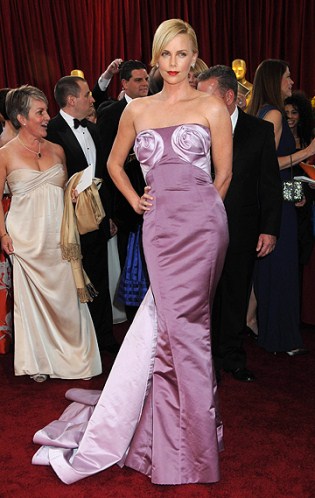
But I don’t really care about any of that, because I like looking at the dresses, and while I can take or leave the ceremony itself, I do love the red carpet moments. Last night’s costume choices seemed to be dominated by an inexplicable preference for silver, grey and silvery-grey dresses that made the wearers look thin and pale and bosomless, but I suspect that’s a popular look in Hollywood all the year round. Three cheers, then, for Charlize Theron, who couldn’t look bad if she tried, but who I thought looked sensational in this dress, which walks the unsteady line between old-style glamour and Bjork-ish overindulgence, and gets it exactly right:

On TV it seemed pinker than it looks here, so the clash with the red lipstick was stronger. Those boob-roses are almost too much, but the old-fashioned shape of the rest of the dress and the elegant hair and lack of accessories bring the overall effect right back to understated glamour. She looks classy and interesting and hellasexy all at once.

My favourite red carpet interview was with that nice chap Colin Firth, who as far as I could tell in two hours of watching was the only nominee who, when pulled over for questioning by Ryan Seacrest, shuffled around to make some more space in front of the camera and included his wife in the interview. “And here’s Livia!”, he said brightly, as though she was the real star for whom they’d all been waiting. What a nice man, and how nice to see a couple who seemed not to have to make an effort to look as though they were enjoying each other’s company. And what a strange place Hollywood is.

Donatello and the eggs

I can’t remember why I decided to study art history at university, but I know exactly why I decided to do it at Essex. I can still visualise that line in the 1994 prospectus, glittering with romantic possibilities:

In the second year, as part of the Renaissance Art and Architecture module, students will make a ten-day study trip to Florence.

When I was seventeen the furthest I’d been from home was France, or possibly Wales. The prospect of a paid-for trip to Italy – to Florence – sounded impossibly, dazzlingly exciting. So I applied to Essex, and was invited in for an interview, in advance of which I removed a sling from my injured arm at my mother’s insistence (“if you go in wearing a sling, all they’ll remember about you is the sling”), and was eventually offered a place. I still didn’t quite believe I’d ever really make it to Florence (Florence!), but there was plenty to get excited about in the meantime.

The trip drew near. “Bring warm clothing”, read the set of instructions which we were all sent before Christmas. “Italy can be quite chilly in January.” “Bollocks”, I thought. “It’s Italy. Of course it’ll be hot.” I packed sun dresses and cardigans. We flew to Florence. It was freezing. We spent ten days freezing, drinking coffee and wine, visiting churches, eating pastries, sleeping for four hours a night, looking at art, falling in and out of love with each other and drinking more wine. I was nineteen and it was everything I had hoped for.

Back in Wivenhoe, we had bonded. We had told each other all our deepest secrets, made each other laugh and cry, and swapped all of our clothes. We wrote essays together and shared textbooks. The one book we each had our own copy of, because it was only £6.99 (I have it here, so I know) was Vasari’s Lives of the Artists, published in 1550; an extraordinarily personal and vital account of the lives of the people whose work we’d encountered in Florence, some of whom Vasari actually knew. As interesting for what it told us about Vasari as for what it revealed about its subjects, it was a book we all knew inside out. And our favourite story was the story of Donatello and the eggs. I’ll let Giorgio tell it himself:

[Donatello] made a crucifix over which he took extraordinary pains. When he had finished it, convinced that he had produced a very rare work, he asked his close friend, Filippo Brunelleschi, for his opinion. But Filippo, in view of what he had already been told by Donatello, was expecting to be shown something far better;  and when he saw what it was he merely smiled to himself. At this Donatello begged him for the sake of their friendship to say what he thought of it. So Filippo, being always ready to oblige,  answered that it seemed to him that Donatello had put on the cross the body of a peasant, not the body of  Jesus Christ which was most delicate and in every part the most perfect human form ever created. Finding that instead of being praised, as he had hoped, he was being criticized, and more sharply than he could ever have imagined, Donatello retorted: “If it was as easy to make something as it is to criticize, my Christ would really look to you like Christ. So you get some wood and try to make one yourself.”

Without another word, Filippo returned home and secretly started work on a crucifix,  determined to vindicate his own judgement by surpassing Donatello; and after several months he brought it to perfection. Then one morning he asked Donatello to have dinner with him, and Donatello accepted. On their way to Filippo’s house they came to the Old Market where Filippo bought a few things and gave them to Donatello, saying: “Take these home and wait for me. I shall be along in a moment.”

So Donatello went on ahead into the house, and going into the hall he saw, placed in a good light, Filippo’s crucifix. He paused to study it and found it so perfect that he was completely overwhelmed and dropped his hands in astonishment; whereupon his apron fell and the eggs, the cheeses, and the rest of the shopping tumbled to the floor and everything was broken into pieces. He was still standing there in amazement, looking as if he had lost his wits, when Filippo came up and said laughingly:

“What’s your design, Donatello? What are we going to eat now that you’ve broken anything?”

“Myself,” Donatello answered, “I’ve had my share for this morning. If you want yours, take it. But no more, please. Your job is making Christs and mine is making peasants.”

We loved this story. It had everything: friendship, conflict, local colour and domestic catastrophe. It made the artists seem human in a way that nothing we’d seen or read before had done. When exam time rolled around we made a pact: we would all try and get the story of Donatello and the eggs into one of our exam answers, somehow. It was a silly story and no doubt we’d all be marked down for including it where it wasn’t relevant, but we didn’t care. We were nineteen.

On the day of the exam, we were all slightly giggly. We entered the exam room. We started to feel nervous (I have an anxious feeling in the pit of my stomach right now, reliving it). We turned the papers over. The first question read:

What evidence is there for rivalry among Renaissance Florentine artists?

The room rippled with suppressed laughter as we all tried to avoid catching one another’s eyes. I don’t think I’ve ever enjoyed an exam so much in my life.

The reverse bullshit principle

I learned a lot in my four years at university, but I can’t explain why some of what I learned has long receded from my memory and some remains crystal-clear. I could tell you all about Haussman’s Paris, and quite a lot about Georges Seurat, and a fair amount about new towns. But I spent as long learning about German Expressionism as I did any of those other things, and of that once-treasured knowledge I have retained exactly nothing.

The most useful thing I learned at university, though, didn’t have anything to do with my degree course, and I am delighted to be able to pass it on to you now, having been reminded of it this morning by a job advertisement that was looking for “committed and capable” candidates. With lifelong gratitude to Professor Peter Vergo, who taught it to me, I present you with The Reverse Bullshit Principle.

The reverse bullshit principle (you need only cap it up the first time) holds that if, when the sentiments contained in a given statement are reversed, the statement becomes ridiculous, then it wasn’t worth making to begin with.

For example, this sentence, taken from a different job advert:

In addition, the applicant must want to be a contributor on a team that strives for excellence and continuous improvement on a daily basis.

Could, when subjected to the reverse bullshit principle, be rewritten thus:

In addition, the applicant must want to be a contributor on a team that strives for mediocrity and sporadic improvement on an infrequent basis.

As the example illustrates, if the opposite of what you’re saying is clearly ridiculous, then what you’re saying should – well, it should go without saying.

The use of the reverse bullshit principle makes it easier to work out when someone is spouting nonsense for the sake of making a noise, rather than because they have anything worth saying. It is useful in all walks of life, but writers in particular should take careful note of it. When I worked in a bookshop we used to sell a remarkably high number of copies of a book called The Career Guide for Creative And Unconventional People (I am linking to it so you can see the font they used for the front cover, which should have provided a clue if nothing else did that this was not a volume worth reading). I longed for the day when someone would come in and say “Ah, but I’m unimaginative and ordinary, so that’s not the book for me!”.

Tomorrow, when I am at home and have the relevant volume with me (I need to quote from Vasari), I will tell you about the second most interesting thing I learned at university.

Hello, goodbye

Just a quick post to reassure you if you thought I might have eloped, gone to jail or been hospitalised. Work is very busy just now, and I’ve got various non-gladallover writing things happening (but none worth mentioning just yet), and between it all I haven’t had a chance to blog very much over the last couple of weeks. I’ll be back. In the meantime, here’s this (click on it if you can’t read the text):