Bread

There’s something fundamental about bread, if you live in the west. For all the whinging about carbs, we all know that bread is the stuff of life, which is why I always bake it when people are ill, or have a new baby, or are bereaved. Bread is sensible and practical and delicious. If I had to live on one foodstuff, it might be bread.

This recipe is for my mum’s bread, which means it’s older than I am. Here is my mum:

Mum

When I tried to get her to write the recipe down a couple of years ago she didn’t know any of the quantities, so she just gave me the list of ingredients and told me to experiment until I worked out how much of everything to use, which means I don’t know any of the quantities either. But the good news is, it doesn’t much matter: every single one of my experiments produced an entirely edible loaf.

This is a really dark, moist, flavoursome bread: as a child desperate for white sliced bread I used to try to avoid it, but now it’s one of my favourite things to eat. There are only two of us at home so I tend to make a smallish loaf, but you could up the quantities if you wanted to.

Ingredients

1lb wholemeal bread flour

A biggish dollop of molasses or black treacle

A handful of caraway seeds

Lukewarm water (less than half a glassful to begin with – you can add more as you, ahem, knead it)

A biggish pinch of dried yeast

Method

Pour all the ingredients into a large bowl and mix them with your hands until you have a ball of quite sticky dough. Cover the bowl with clingfilm or a tea towel and leave it somewhere warm for 30-60 minutes, or until the dough has roughly doubled in size (but don’t worry if it doesn’t expand that much – as long as it has perceptibly risen by the time you put it in the oven, you’ll be OK).

Grease the inside of a 1lb bread tin and transfer the dough into it. It doesn’t matter if it doesn’t sit perfectly level in the tin; wonky edges are part of the charm of home-made bread. Put the tin in an oven preheated to around 200 degrees for twenty minutes, then turn down the oven to 160ish for another half an hour.

(You might want to fiddle with those temperatures and timings depending on your oven: mine is a fan oven, so increase one or the other if yours isn’t. Turning the temperature down partway through cooking seems to prevent the crust from becoming too tough.)

After around fifty minutes, take the bread out of the oven and tip it out of the tin (you may need to employ a knife here if the greasing hasn’t done its job properly, in which case try not to scrape the coating off the inside of your tin, or it’ll be even stickier next time). Tap the underside of the loaf with the edge of a knife or the back of a spoon: if it sounds hollow, it’s cooked. Leave it to stand on a wire tray (I use the grill tray because my bijou kitchen doesn’t have space for anything that isn’t multifunctional) for at least twenty minutes. Eat while still warm with salad and gooey French cheese for a perfect summer supper. Then toast it the next day for breakfast: you’ll need your grill (or toaster, if you are one of those people with space for a toaster) turned up high, because the moistness of the bread means it’s fairly resistant to heat.

Caroway seeds are Mum’s original flavouring and are great, but you can experiment with other additions: black onion seeds, for example, give it a lovely hint of fire. I’d like to try it with dried chillis, too, but I haven’t gotten around to that yet.

Here’s this morning’s loaf:
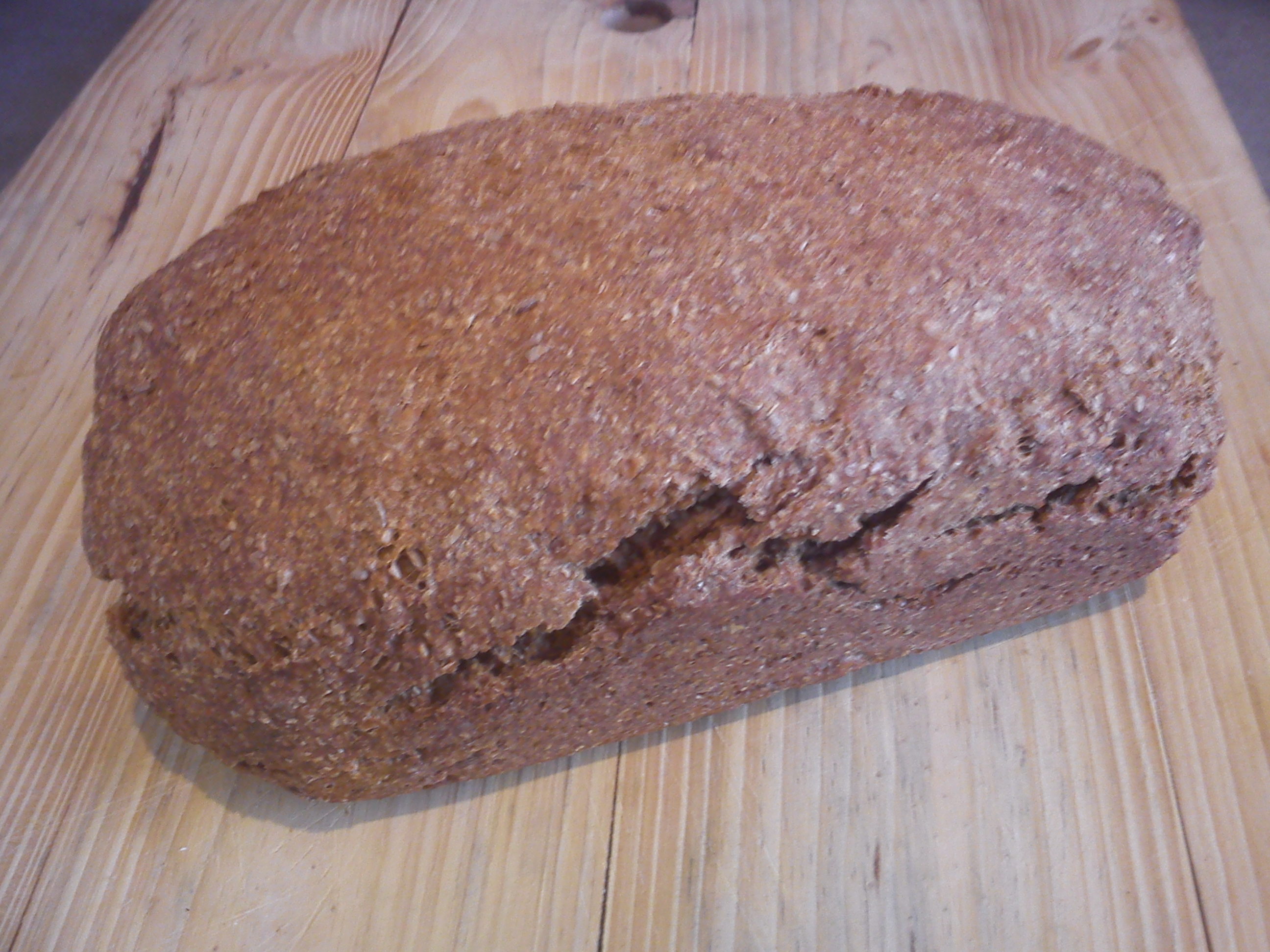
Loaf of breadTip: slice it thinly, because it’s heavier than your average loaf of bread, so a little goes a long way.
The blogroll

I’ve added some links to my blogroll, so I thought I’d take the time to write a little bit about each of them.

Jamie Oliver and Delia Online are pretty self-explanatory. I use recipes by plenty of other people, but if I’m looking for a basic recipe I’ll go to Delia for the reliable version and Jamie for a twist on the original. If I’m doing something that is likely to require precision, like baking a pudding or a cake, I know I’ll get a tried-and-tested and uncomplicated solution from Delia. Jamie’s recipes are a bit more haphazard (a slosh of this, a handful of that), but since that’s how I cook anyway, I don’t mind it.

Eat like a girl is the lovely Niamh, with whom I used to work in a non-food-related setting. I only found her blog by accident after I friended her on Facebook, but it turned out she was one of the UK’s best and best-known food bloggers, and she’s recently been rightly rewarded with a book deal. Comfort and Spice comes out later this year, and I’m really looking forward to it. She writes about recipes, restaurants and food-related events in a straightforward and engaging way.

The London Feminist Discussion Group is the online presence for a women’s reading group which I belong to. The blog discusses all kinds of issues relating to feminism, while the group meets up irregularly for book discussions and clothes swaps. They have some really interesting things to say on a lot of subjects, and I hope to lure one of two of them over here at some point for some guest posts.

Really Hungry is recipes and foodie tales from Jane, who is living the dream by ditching her highly-paid sales job and going back to college to become a chef. Like Niamh’s, her recipes are interesting without being too difficult to attempt. She also looks very cute in her chef’s whites.

Shapely Prose is no longer updated, but the archive is worth reading. It was where Kate Harding and a series of other bloggers wrote about feminism and fat acceptance. It’s also the home of the BMI project, which explained more articulately than words ever could why the concept of BMI as a useful indicator of health, size or anything else was a nonsense.

The Rotund is Marianne Kirby, who along with Kate Harding wrote Lessons From The Fat-O-Sphere, the book which we read in the women’s group which started off the thought process which has led to All Stewed Up. Marianne writes wittily and tirelessly about the politics of being fat, and anything else that takes her fancy.

I’ll add more links as I come across them.

Hello

This is a blog about food, but it’s not a food blog. There are enough of those already, and I’m not a chef – although I will post recipes, because I like to cook and I like to share the results. It’s not a blog about health and nutrition, because I’m not qualified to talk about those things with any authority. And it’s definitely not a diet blog. In fact it’s the opposite of a diet blog: it’s about enjoying eating without feeling guilty about it. Sounds simple, doesn’t it? We’ll see.

A week from now I’ll post a food diary listing everything I have eaten this week. I think food diaries are mostly stupid, but I won’t be using it to learn about my “bad” habits or shock myself into eating less or differently: I’ll just be using it as a kicking-off point for a conversation about my own eating choices and what prompted me to start writing about food, in between writing about plays and writing my never-to-be-published novel and writing about my noisy neighbour and writing about furniture and going to the recordings of my never-to-be-broadcast radio play – and, sometimes, doing my actual job. And wedding planning. In between all of those things.

Damn

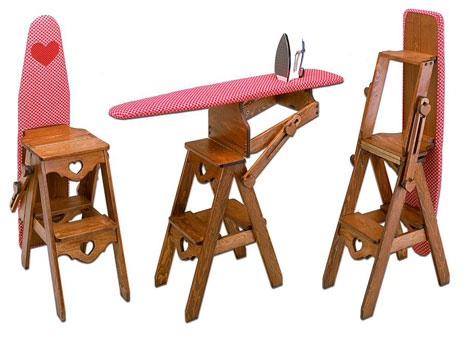
It’s the love that can never be. I have fallen head over heels for this piece of furniture – variously known as a bachelor chair, a Jefferson chair or, apparently, an onit – but as far as I can tell from the internet, you can only buy it from Grandpa’s Crafts, and I suspect that the complexities of shipping it from North Carolina would be beyond me. And anyway, I’m not supposed to be spending money.

But isn’t it amazing? It’s a chair that is also an ironing board that is also a stepladder:

the bachelor chair

It’s up there with the toilet that you wash your hands in for space-saving elegance. Maybe I should just move to North Carolina. It’s warmer there too, right?

Banned words

As of today, I am experimenting with being assured and unambiguous in my writing style. Here is a list of words which are henceforth banned:

Almost

Maybe

Possibly

Probably

Could

Might

If you spot me using any of them or their derivatives, please issue a sharp admonishment.

Busby Berkeley Dreams

I don’t usually listen to music on the way to work. I read, or look out of the window; music seems a little too invasive and involving for that time in the morning. But today – with the sun out and the weekend looming – it felt like a day for music.

I put the iPod on shuffle and the first song it played me was the Magnetic Fields’ Busby Berkeley Dreams, which, as it turns out, is a terrible song to listen to on the bus, especially if, like me, you cry at the drop of a hat and happen to be wearing mascara. Fortunately I was also wearing sunglasses, so I think I got away with it.

Unrelatedly, I went to see the Pet Shop Boys’ ballet this week, and it has a stunning section in the middle which includes a kaleidoscopic dance, where bodies stop being bodies and become synchronised parts of a mesmerising machine. Of all the performing arts dancing is the one I understand the least, but sometimes it can be transfixing and transporting in a way that nothing else is.

Anyway, some dude on the internet has put together a video sequence to accompany the song, and since I can’t share the ballet with you this is the next best thing, just as long as you have your hanky at the ready:


Confused of Herne Hill

As far as I can make out, the UK is either about to start or has already started bombing Libya. This seems to have happened almost overnight with very little discussion or preparation, and I am reminded of 2003 and the weeks of protest (ours) and handwringing (theirs) that preceded the invasion of Iraq. The main difference this time around seems to be that the French are joining in, but that doesn’t seem a good enough reason to go ahead and do it without debate.

It’s easy to cry “oil”; so easy that I’m never sure it’s true. But if it’s not about oil, I have literally no idea why we get involved in the internal conflicts of some countries but not others. Gaddafi may be mad and dangerous, but so is Mugabe and so, no doubt, are lots of other people that we’re not interested in at all. But if it is about oil we can’t say so, which means we need other justification, except I haven’t heard any, so maybe we don’t even need justification any more. Maybe we just need France to say yes. I have no idea. All I know is that the effects of intervention in Iraq and Afghanistan were devastating, and that nobody is safer because of them. So unless it’s specifically about getting rid of a particular regime without much caring about what happens next, which seems short-sighted even for politicians, I’m stumped.

But then, I am easily stumped. I don’t understand why anyone thinks it’s OK for the countries with nuclear weapons to dictate which other countries should be allowed to have them, as though there’s some kind of ineffable hierarchy which says that the richest countries are allowed to decide what happens in the others. I thought we had stopped equating moral superiority with privilege around the time we stopped believing in the divine right of monarchs, but apparently not.

And I don’t understand why one o’clock clubs and play schemes and libraries are being closed while companies like Vodafone and Boots avoid paying billions of pounds in taxes, as though they and the government think nobody will notice, or that if we do, we can’t do anything about it. But one thing we know from watching Libya and Egypt and everywhere else that’s seen grass-roots dissent this year is that if there are enough of us, we can do something about it, which is why I will be joining the TUC’s March for the Alternative this Saturday, March 26th, in London. Because when I stop to think about it I’m not so much confused as angry, and there are some people I’d like to know about it.

Olympic countdown

I walked past the Olympic countdown clock in Trafalgar Square this morning:

Olympics countdown clock

It went up last night and it will count down the 500 days until the London Olympics begin next August. I walk across Trafalgar Square every weekday, so I’ll be able to keep a close eye on it and make sure nobody’s cheating.

Tickets for the various Olympic events also went on sale today. The process for buying them seems complicated, excluding and unfair, but I’m still going to try to get hold of some, which I suppose is what they’re counting on. If you have a monopoly on a hugely popular commodity, you can pretty much do what you like with it.

It’s disappointing that the ticket sales mechanism is so badly-designed, but not as disappointing as the design of that logo. Have another look at it:

London 2012 logo

I mean, what? It doesn’t even look like anything. It certainly doesn’t look like the numbers “2012”, unless you squint really hard. When it was first unveiled four years ago we were assured that we’d get used to it. Tessa Jowell, my MP and at that time the Olympics Minister, said:

“This is an iconic brand that sums up what London 2012 is all about – an inclusive, welcoming and diverse Games that involves the whole country.

“It takes our values to the world beyond our shores, acting both as an invitation and an inspiration.

“This is not just a marketing logo, but a symbol that will become familiar, instantly recognisable and associated with our Games in so many ways during the next five years.”

That’s clearly all bollocks, but what is especially bollocks is the part about it being “iconic”. When you use the word “iconic” to describe something that looks like this:

London 2012 logo

You pretty much defile its use to describe things that look like this:

Union flag

Or like this:

Penguin Classics covers

Or like this:

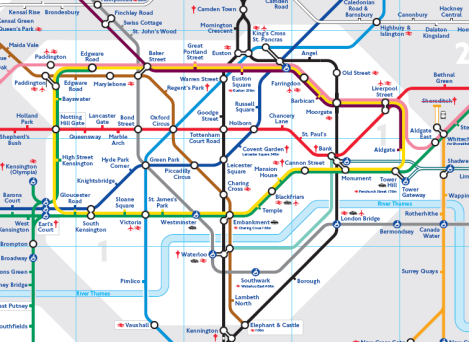
London Underground map

Still, at least the London 2012 website doesn’t look like this any more:

London2012.com 2007 design

I suppose that’s something.