How to follow the Oscars

Joe Levine and Sophia Loren at the Oscars
Any excuse for a photo of Sophia Loren

If you are in the UK and want to follow the action from this Sunday night’s Oscars ceremony, there are lots of ways to do it that don’t involve taking out a Sky subscription. One of them is illegal so of COURSE I shan’t mention it here, but lots of them aren’t. Here are my picks:

  • The Oscars website has a “buzz” section showing an aggregation of Oscars-related tweets which is already trotting along at a healthy rate, leading me to suspect that it might start moving so fast as to be unreadable on the night. For a more streamlined view, try following @TheAcademy, tweeting from behind the scenes, @OscarInterviews for glimpses of the stars and @OscarGoer for an audience-eye-view of the ceremony.
  • The red carpet is being shown live on E!, which I think is on Freeview, although half-hearted attempts at independent verification of this have failed, because I can’t work the internet. Anyway, it’s definitely available through Virgin cable packages, and you can always come over and watch it at mine. Bring popcorn.
  • If you want to go meta, follow @LostRemote, who will be tweeting all of “their favourite social media moments” on the night.
  • Finally, an all-woman team featuring Jo, TindaraConcetta and your correspondent will be live-blogging the whole affair from 11.30ish on Sunday evening over at Mostly Film, as well as taking over the Mostly Film twitter account for the evening (I have promised not to tweet every thirty seconds, but who knows where the mood will take me?).

What do Stanley Kubrick, Thelonious Monk and Groucho Marx have in common?

Thelonious Monk
Clue: the answer is not "facial hair"

Give up? You might as well, because you’re not going to guess. It’s that they all brightened up my lunchtime today, courtesy of the always-fascinating Letters of Note and its upstart sibling Lists of Note. Stop what you’re doing and read all three of them: it’s worth it.

Stanley Kubrick’s list of titles in search of a script

Thelonious Monk’s advice to musicians

Groucho Marx’s letter to the Franklin Corporation

You’re welcome.

Social contract for product managers (WARNING: work-related)

I just came across an article by Marty Cagan (author of Inspired: How to Create Products Customers Love, which is worth reading if you make stuff for a living), about a list of promises you can make to yourself and your team that will help you to do a better job. Here they are:

  • We will not complain about the workload [I LOVE this one]
  • We will launch our product/service in the market
  • We will think with our hands through rapid prototyping
  • We will use both sides of our brains (creative and analytical)
  • We will approach every activity with an open mind and a beginner’s mind
  • We will strive to continuously improve how we create and launch products

I really like it as a set of principles, and I think it’s useful for everyone working in a technological environment, not just product managers. Read the original post here.

Sherlock

If you don’t like a TV programme, you should probably stop watching after the first episode, rather than keep watching and getting a bit crosser each time. Although, actually, I quite liked the first episode of Sherlock. It was the second, startlingly racist, episode that put me off, but somehow I kept watching, even when the third episode was unsatisfying and then we had to wait a year for number four. I can’t really explain it, except that I kept hoping it would get better.

And it wasn’t awful. There was lots to like about it: the casting is uniformly excellent and everybody does the best they can with the script. It looks good, and it sounds good, and it makes London look better than it does in real life.

But ugh, it’s so pleased with itself! The joy of the Conan Doyle stories comes from how clever Sherlock Holmes is, not how clever Arthur Conan Doyle is. It’s a small, but important, distinction. Sherlock is delighted by itself more than it is by the character, which makes it feel all wrong. I don’t want to be able to hear the programme-maker breathing down the back of my neck when I watch a drama, and watching this show I can feel him looming sweatily over me throughout.

(I’m not talking about anyone in particular here, but he is definitely a “he”. Drama on British TV is currently in the grip of a chummy group of clever-clever, white, middle-class men who are all jolly pleased with themselves and each other for being smarter than normal people. Unfortunately they are all quite good at making TV, damn them, but that doesn’t mean I have to like them.)

The problem the programme has, when it gets very overexcited about being clever, is twofold. Firstly, it loses sight of the beautiful simplicity that sits at the heart of the best Holmes stories. This show has more plot in ten minutes than an entire Conan Doyle novel. Secondly, if you’re going to be self-consciously clever, you’d better make sure that you are, in fact, being clever, and this is where Sherlock falls down for me. Quite apart from the dangling plot points and the baffling improbabilities, which flit by so fast that you can mostly ignore them, the show is terrifically excited about Technology, which somebody somewhere in the bowels of the BBC has clearly decided is going to be used as a Metaphor. The problem is, they haven’t bothered to get anyone with an actual grasp of the technology they’re talking about to act as an advisor on the show, with the result that we, the audience, are expected to be delighted by Feats of Technology which in real life are either ridiculously unimpressive or so improbable and unexplained as to be plain silly. Just as The Archers needs an agricultural story editor, Sherlock could have done with a technology advisor. And somebody should have sacked whoever decided to give Watson a “blog”. I put it in inverted commas because so do they, every time they mention it.

But that’s all nit-picking. What I really object to is the idea that the source material needs to be improved upon, when (a) it doesn’t, and (b) whatever description you might want to give of Sherlock, an improvement on the original is not it. At one point, during the entirely nonsensical denouement of last night’s show, Moriarty (wince-inducingly described in BBC1’s preamble as “Holmes’s ultimate nemesis”, as though you can have grades of nemesis) said to Holmes: “…that’s your weakness, you always want everything to be clever”. And I thought: you got it in one.

(I had a separate rant last night at the TV and the beloved about what they did with Moriarty, but since it included the words “postmodern” and “non-linear” I shan’t repeat it here, or we’ll both go away thinking I’m the most terrible kind of wanker.)

Elsie and the Magic Torch

I suffer from intermittent insomnia. I’ve never had a problem getting to sleep, but I sometimes wake up in the small hours and I can’t get back to sleep. Or at least, that used to be true until I discovered that if I put ear plugs in the moment I wake up, it somehow serves to switch me back off, and I can sleep peacefully again until the alarm wakes the beloved and he nudges me to tell me it’s time to resume consciousness.

So that’s good. But I can’t go to the loo with ear plugs in – it’s like going indoors with sunglasses on: I feel impaired. So when I got up and went to the loo last night I took my ear plugs out, and promptly dropped one of them on the floor. Hmm, I thought as I padded to the bathroom and back. I won’t get back to sleep without that, but I’ve no idea where it went. What I need is a torch.

And as I sleepily thought about where I might find a torch, I remembered that in July we went to the Hop Farm Festival. We had day tickets, but it was the men’s final at Wimbledon and we didn’t leave the house until around 6pm, so we only caught the end of Tinie Tempah, followed by Prince, who was the reason we were there in the first place, so it was all fine. Except that at around 10pm I decided to go to the loo (sorry, I know this is a more than usually lavatorial post. I can only apologise and assure you that it’s entirely pertinent to the story), and it was night time, and I realised I was going to have to pee in a portaloo in the dark. That doesn’t sound like fun, I thought, and then I thought a bit more, took out my phone, found the apps market and searched for “torch”.

If you search the apps market for “torch” you get 801 results. The one I chose is called “Brightest Flashlight Free”, and it is all of those things. It takes what I assume is the flash function of the camera inside my phone and turns it into a beam of white light, which lasts for as long as you keep the app open. I was so surprised that I flashed it into my eyes, momentarily blinding myself.

It was only last night, thinking about where I could find a torch, that I realised that at 10pm on a Sunday night in a field in Kent, by pressing a few times on a piece of glass, I had summoned up a torch where none had existed before.

Well, I mean, really that’s almost witchcraft, isn’t it?

By that time I had found the rogue ear plug without the aid of a torch, but I was so struck by the realisation that my smartphone had made it possible for me to magic up a physical tool which I didn’t have prior to that point that I stayed awake for another hour thinking about it. What a weird and fantastic, in every sense, world we have made for ourselves. And how lucky to be alive now, when everything changes so quickly that my grandmothers would only recognise about half of the things I spend my time doing.

(I never used the torch that night at the Hop Farm Festival, by the way. It turned out the portaloos had little lights of their own on the inside. But still.)

Postsecret

Do you know Postsecret? You write your secret on a postcard and send it to Frank, who publishes a long list of them every Sunday. It’s funny and sad and scary and always worth reading. Yesterday’s post starts with this secret:

Ever since I found out that my mom had plastic surgery I can't stop wondering what she would change about my body.

I stopped and looked at it for quite a long time, and not just because Marilyn is so gorgeous (though partly that, obviously). I think the message is quite important. If I tell you that I hate my nose, I’m telling you that there’s an acceptable and an unacceptable way for noses to be, and if you’re the kind of person to worry, you may well start to worry about your own nose. So body criticism is an aggressive act, even when it’s directed inwards. I must try to remember that.

Plus one

I don’t often, by which I mean ever, write about work-related things here. I want to say it’s because I don’t have the time, but there are plenty of people with tougher jobs than mine who nonetheless manage to write about them regularly. Maybe it’s because although I think my work is interesting, I can see how other people might not.

But today I want to talk a little bit about Google Plus, the new social tool from Google which launched a couple of weeks ago, so this post is in the nature of an experiment. Feel free to skip it; there’s bound to be a post about kittens falling over soon.

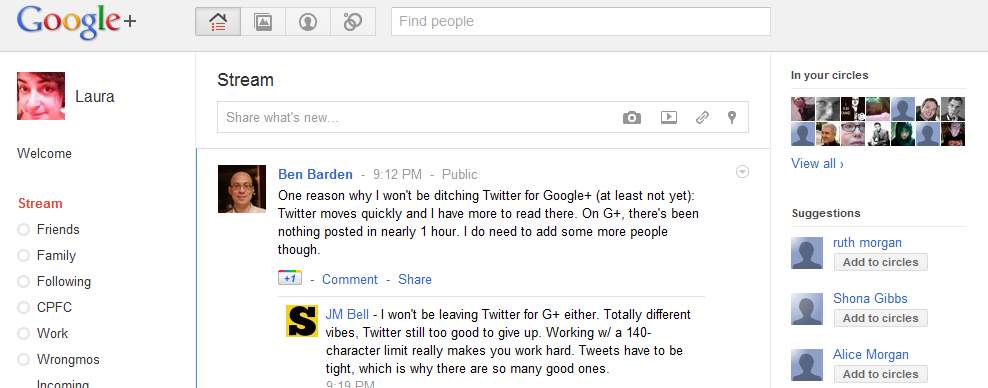
Still here? Excellent. So, first impressions. It looks a whole lot like Facebook:

Google plus homepage

(You might need to click on the image to see it properly.)

As far as I can tell, the main functional difference between G+ and Facebook is a feature which, actually, Facebook already has, but which it doesn’t make much of. Facebook calls it “lists”; G+ calls it “circles”, but the idea is the same: you divide your contacts into groups so that you can target what you share at particular sets of people.

So, for example, I might post a picture of my new baby niece and share it with my “Friends” and “Family” circles, but not with “Work”, “Following” (I use that one for people I don’t know at all) or “Public” (if I mark a post as “Public” it means anyone who looks at my profile or has me in a circle can see it). Likewise, if I want to ask a technical question or share some thoughts on the latest radio industry news, I might just share it with my “Work” and “Following” circles.

What that means is that I can now get my tech news, my music news, my media news and my friends’ news all in the same place; I can decide what I want to share with which people, and I can dip in and out of it just like I do now with Twitter or Facebook.

So that’s one positive. Another is that you can easily make connections with people you don’t know, in a way that allows much more and easier interaction than Twitter does. Let’s say you and I are both big fans of Limmy. Limmy writes a post (that’s what I’m calling them for now; they may end up with a different name) on G+ and you and I both read it and comment on it. I see your comment, click on your name and see that we have things in common, or I just like the sound of you, so I click “Add to circles” and stick you in my “Following” circle. You get a notification that tells you I’ve done that, so you check out my profile and can decide whether to add me to one or your circles. We’ve never met and we live thousands of miles apart, but now we can share ideas, photos, video, music and more. That’s kind of exciting.

I don’t think G+ will replace Facebook, because they serve a different need. I have 271 friends on Facebook (all but one of whom I know from real life), and right now Facebook is giving most of them everything they need from a social network. Some of them will join G+, but Facebook can copy any feature that G+ has in a matter of days or weeks, which is always going to be a shorter time than it takes the majority of people to be persuaded to move elsewhere.

I don’t think G+ will replace Twitter, because again, they’re very different animals. The 140-character restriction on Twitter and the super-fast stream of information it can provide when you follow enough people mean it’s the best place for breaking news and terrible one-liners. G+ won’t change that.

As I said elsewhere on recently, I think Tumblr is probably going to suffer the most from the launch of G+, because it doesn’t have a USP that distinguishes it from the competition.  But we’ll see. G+ is only a couple of weeks old and isn’t fully rolled out to the public yet, so the story has barely begun. We knew Facebook had made it when instead of saying “I’ll send you a friend request on Facebook”, they started saying “I’ll friend you”, and we all knew what they meant. So for now, I’m just waiting for someone to tell me: “I’ll circle you”.