Peace at last

Did I happen to mention that I was reading War and Peace? I finished it last weekend, but I was so drained by the whole experience that it’s taken me a week (during which I read the Everyman Book of Detective Stories, Dan Rhodes’ Anthropology and the first 200 pages of The Phantom of the Opera: god, but it’s good to have my reading mojo back) to marshall my thoughts on it.

Thanks to a wise old Russian woman I once knew who declared that when it came to War and Peace she “only read the Peace”, I had always thought that War and Peace was neatly divided into alternating sections. It does begin that way, but gradually the two strands resolve into a single story. And there’s a third strand, which has nothing to do with any of the rest of it and reads as though it was written by someone else entirely, which consists of intermittent discussions on history and military tactics and how the two are related. You can spot these sections immediately because the close-set narrative voice disappears and we swoop out to an omniscient level that is somewhere on a par with god.

I enjoyed 90% of the peace, 50% of the war and 50% of the philosophy, which mathematically makes this a success story, except that when you take those numbers and apply them to a 1400-page book, assuming for the sake of convenience that each strand constitutes about a third of the whole, you are still left with 500-odd pages of big fat no fun. Add that (yes, more maths!) to the voices of the various people who warned me before I started that the final section of the book was impenetrably dull, and you begin to see why I picked it up with a slight but perceptible sense of doom each time.

The other problem I had was that there are so many characters; so many stories to follow, that it’s hard to know which of them to care about. Even Leo himself seems to have lost track, because several threads are started which never go anywhere. The story starts in the elegant salon of Anna Pavlova Scherer, a bewitching and playful woman whom I expected to loom large in what followed, but she is barely mentioned again. Other characters appear and disappear without consequence; people make spectacular entrances early on, then die abruptly a thousand pages later without having been mentioned in the interim. It took Tolstoy five years to write War and Peace, and I can’t help thinking that by the time he got to the end, he had forgotten the beginning.

I did enjoy most of the Peace, though. The Rostovs are a seductive, chaotic, convincing mess of a family, and the various people who walk in and out of their lives are all worth meeting, though Count Anatole, like his sister Helen, is a pantomime villain. The contrast with the sadder and sterner Bolkonskys is good, too. And I enjoyed the various romances very much, even if they did (with one exception) all get wrapped up in a sentence or two, Tolstoy clearly not sharing my avid interest in the small rituals of betrothal and marriage.

The War is good when things are happening, and less good when nothing is, which is often. I struggled with long descriptions of where the army were stationed, and the benefits and disadvantages their position offered. It may have been beautifully observed, but it was also quite boring. And I have never been able to discern the hierarchy of the various ranks, so I’m sure some subtleties were lost on me there.

I didn’t mind the philosophical stuff, although it suffers from the same problem it criticises in written accounts of history, which is the assumption that the author is capable of abstracting himself from his own time and circumstances and writing objectively about the world. And the last section, a 44-page essay on the nature and meaning of free will, is interesting and I’m glad I read it, but I wish it wasn’t the final section of War and Peace, because the section immediately before it would have made a perfect ending. Without giving too much away, here is what would have been the final paragraph of the book had it ended where it should have done, with the firstborn of the new generation contemplating his family’s past and future:

‘Non’ answered Nikolai, and fell back on his pillow. ‘He is good and kind and I am fond of him,’ he said to himself, thinking of Desalles. ‘But Uncle Pierre! Oh, what a wonderful person he is! And my father? Oh, Father, Father! Yes, I will do something that even he would be content with…’.

And here is the actual last paragraph:

In the first case it was necessary to surmount the sensation of an unreal mobility in space and to recognize an emotion we did not feel. In the present case it is similarly necessary to renounce a freedom that does not exist and to recognize a dependence of which we are not personally conscious.

See?

I am glad to have read War and Peace, if only because it’s something I thought I didn’t have the discipline and earnestness of intention ever to do. And there’s lots in there that’s good, and although I wouldn’t unhesitatingly recommend it, I certainly wouldn’t warn you off it. But I am enjoying The Phantom of the Opera more than I’ve ever enjoyed a book, and that’s not because it’s very good (it isn’t).
The Oscars

I always think the Oscars are kind of a strange idea. I used to imagine annual awards for accountancy, say, or plumbing, and use them as an illustration of what why I thought the Oscars were kind of a strange idea, but there probably are annual awards for accountancy and plumbing these days, and what’s more they are probably televised, so my illustration no longer works. Nonetheless, I do think it’s weird to give prizes to people for doing their jobs, and for a self-appointed committee to decide what’s “best” in a competition which is limited in its scope and necessarily subjective. You might as well give a prize for the “best” marriage guidance counsellor, or the “best” GP.

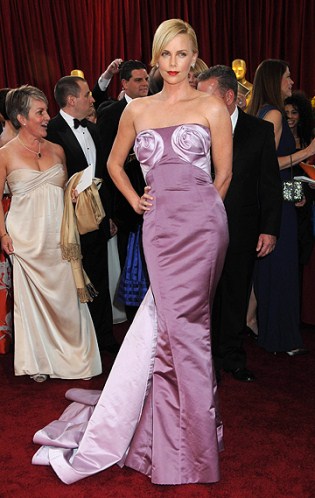
But I don’t really care about any of that, because I like looking at the dresses, and while I can take or leave the ceremony itself, I do love the red carpet moments. Last night’s costume choices seemed to be dominated by an inexplicable preference for silver, grey and silvery-grey dresses that made the wearers look thin and pale and bosomless, but I suspect that’s a popular look in Hollywood all the year round. Three cheers, then, for Charlize Theron, who couldn’t look bad if she tried, but who I thought looked sensational in this dress, which walks the unsteady line between old-style glamour and Bjork-ish overindulgence, and gets it exactly right:

On TV it seemed pinker than it looks here, so the clash with the red lipstick was stronger. Those boob-roses are almost too much, but the old-fashioned shape of the rest of the dress and the elegant hair and lack of accessories bring the overall effect right back to understated glamour. She looks classy and interesting and hellasexy all at once.

My favourite red carpet interview was with that nice chap Colin Firth, who as far as I could tell in two hours of watching was the only nominee who, when pulled over for questioning by Ryan Seacrest, shuffled around to make some more space in front of the camera and included his wife in the interview. “And here’s Livia!”, he said brightly, as though she was the real star for whom they’d all been waiting. What a nice man, and how nice to see a couple who seemed not to have to make an effort to look as though they were enjoying each other’s company. And what a strange place Hollywood is.

Donatello and the eggs

I can’t remember why I decided to study art history at university, but I know exactly why I decided to do it at Essex. I can still visualise that line in the 1994 prospectus, glittering with romantic possibilities:

In the second year, as part of the Renaissance Art and Architecture module, students will make a ten-day study trip to Florence.

When I was seventeen the furthest I’d been from home was France, or possibly Wales. The prospect of a paid-for trip to Italy – to Florence – sounded impossibly, dazzlingly exciting. So I applied to Essex, and was invited in for an interview, in advance of which I removed a sling from my injured arm at my mother’s insistence (“if you go in wearing a sling, all they’ll remember about you is the sling”), and was eventually offered a place. I still didn’t quite believe I’d ever really make it to Florence (Florence!), but there was plenty to get excited about in the meantime.

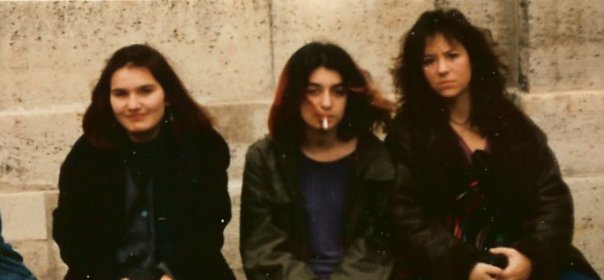
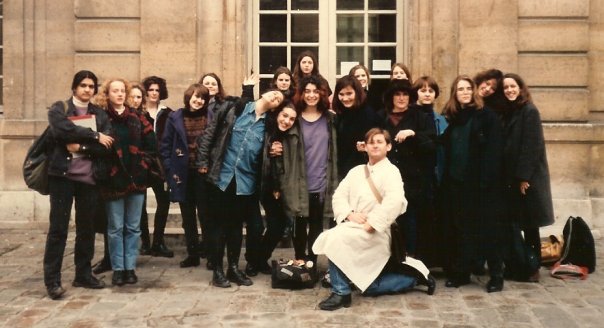
The trip drew near. “Bring warm clothing”, read the set of instructions which we were all sent before Christmas. “Italy can be quite chilly in January.” “Bollocks”, I thought. “It’s Italy. Of course it’ll be hot.” I packed sun dresses and cardigans. We flew to Florence. It was freezing. We spent ten days freezing, drinking coffee and wine, visiting churches, eating pastries, sleeping for four hours a night, looking at art, falling in and out of love with each other and drinking more wine. I was nineteen and it was everything I had hoped for.

Back in Wivenhoe, we had bonded. We had told each other all our deepest secrets, made each other laugh and cry, and swapped all of our clothes. We wrote essays together and shared textbooks. The one book we each had our own copy of, because it was only £6.99 (I have it here, so I know) was Vasari’s Lives of the Artists, published in 1550; an extraordinarily personal and vital account of the lives of the people whose work we’d encountered in Florence, some of whom Vasari actually knew. As interesting for what it told us about Vasari as for what it revealed about its subjects, it was a book we all knew inside out. And our favourite story was the story of Donatello and the eggs. I’ll let Giorgio tell it himself:

[Donatello] made a crucifix over which he took extraordinary pains. When he had finished it, convinced that he had produced a very rare work, he asked his close friend, Filippo Brunelleschi, for his opinion. But Filippo, in view of what he had already been told by Donatello, was expecting to be shown something far better;  and when he saw what it was he merely smiled to himself. At this Donatello begged him for the sake of their friendship to say what he thought of it. So Filippo, being always ready to oblige,  answered that it seemed to him that Donatello had put on the cross the body of a peasant, not the body of  Jesus Christ which was most delicate and in every part the most perfect human form ever created. Finding that instead of being praised, as he had hoped, he was being criticized, and more sharply than he could ever have imagined, Donatello retorted: “If it was as easy to make something as it is to criticize, my Christ would really look to you like Christ. So you get some wood and try to make one yourself.”

Without another word, Filippo returned home and secretly started work on a crucifix,  determined to vindicate his own judgement by surpassing Donatello; and after several months he brought it to perfection. Then one morning he asked Donatello to have dinner with him, and Donatello accepted. On their way to Filippo’s house they came to the Old Market where Filippo bought a few things and gave them to Donatello, saying: “Take these home and wait for me. I shall be along in a moment.”

So Donatello went on ahead into the house, and going into the hall he saw, placed in a good light, Filippo’s crucifix. He paused to study it and found it so perfect that he was completely overwhelmed and dropped his hands in astonishment; whereupon his apron fell and the eggs, the cheeses, and the rest of the shopping tumbled to the floor and everything was broken into pieces. He was still standing there in amazement, looking as if he had lost his wits, when Filippo came up and said laughingly:

“What’s your design, Donatello? What are we going to eat now that you’ve broken anything?”

“Myself,” Donatello answered, “I’ve had my share for this morning. If you want yours, take it. But no more, please. Your job is making Christs and mine is making peasants.”

We loved this story. It had everything: friendship, conflict, local colour and domestic catastrophe. It made the artists seem human in a way that nothing we’d seen or read before had done. When exam time rolled around we made a pact: we would all try and get the story of Donatello and the eggs into one of our exam answers, somehow. It was a silly story and no doubt we’d all be marked down for including it where it wasn’t relevant, but we didn’t care. We were nineteen.

On the day of the exam, we were all slightly giggly. We entered the exam room. We started to feel nervous (I have an anxious feeling in the pit of my stomach right now, reliving it). We turned the papers over. The first question read:

What evidence is there for rivalry among Renaissance Florentine artists?

The room rippled with suppressed laughter as we all tried to avoid catching one another’s eyes. I don’t think I’ve ever enjoyed an exam so much in my life.

Peace by peace

As I may have mentioned here before, I am reading War and Peace. I’ve been reading it since the start of December, when I loftily and optimistically expected to be finished by the new year. As of this morning, I am 1,155 pages in with 289 to go, so I’m well in sight of the finishing line, relatively speaking, but I still don’t quite believe I’m ever going to get there.

Part of the problem is that the physical thing itself is so large that my reading locations are limited. I lug it to and from work every day and read it on the tube, but I can’t read it in bed – which is where I get most of my reading done – because I have a habit of dropping my book on my face when I fall asleep, and doing that with W&P would result in severe facial injuries (or at the very least a nasty shock).

Another distraction is the pile of mystery books I was given last week: I am currently also in the middle of The Penguin Book of Gaslight Crime, which is as much fun as it sounds, and once I’m finished with that I’ve got an anthology of detective stories to read, as well as Agatha Christie’s Secret Notebooks. All of these books draw me in and keep me breathlessly bound to them in a way that War and Peace is not doing, though I admit that the fault may lie with me rather than with Leo. I am so used to reading stories with a mystery that must be solved that I keep waiting for something to happen, some sort of denoumenent or revelation; and I can’t help feeling that all that will happen is that various people will get married and some of them will die, and it all will be a bit like real life, only…longer.

My sister recently emailed from somewhere on the Red Sea and said she’d given up on her current book because, in her words, “I was quite enjoying it, but all the characters had the same name and it always returned to describing war tactics”. Although she happened to be talking about One Hundred Years of Solitude, this is more or less exactly how I feel about War and Peace. I’m going to plough grimly on to the end, however, and will let you know if I experience a sudden change of heart, or if I find out whodunnit.

Early morning rage

I think I need a new radio station to listen to first thing in the morning. On the days when I leap out of bed like the lark it’s not so bad, because I only get to hear the weather forecast, which is all I really need. But on the days when it takes me a little longer to emerge, blinking, from under the duvet, the Today programme is capable of rousing me to a state of apoplexy that isn’t healthy before breakfast.

I have always been bemused by the programme’s apparent remit to challenge everything their guests say, no matter how apparently uncontroversial. Fighting for the sake of a fight seems an unlikely position for a magazine show to take, although some presenters (I’m looking at you, Humphreys and Naughtie) are worse than others.

But a couple of times in the last week or two this stance seems to have tipped over into something a bit more disturbing. After the imprisonment of Metropolitan Police Commander Ali Dizaei earlier this month for misconduct in a public office and perverting the course of justice, John Humphrys interviewed Alfred John, current chairman of the Metropolitan Black Police Association, of which Dizaei was once president. Fair enough, except that a disproportionate amount of time was devoted to whether and to what extent the MBPA had been “discredited” by Dizaei’s conviction.

If a former police officer breaks the law, it’s the police service itself which is discredited (if anyone but the offender is), and not an association his membership of which had nothing to do with the crime for which he was convicted. What was really happening here was that Dizaei had rubbed a lot of people up the wrong way while at the helm of the MBPA, leading to a distrust of the association in some quarters, and this was a chance to smear it by insinuating that Dizaei’s criminal activity was somehow related to his insistence that the Metropolitan Police is still institutionally racist, when the two things are quite seperate. Just because he’s a criminal doesn’t mean he’s wrong about everything. Both Alfred John and the other guest, Brian Paddick, agreed that there is still racism within the police service, and that the MBPA has a legitimate and important job to do.

“Given that you have tried and failed by your own admission”, responded Humphrys, “there must surely be a better way of dealing with this.”

This was a novel twist. The MBPA should be disbanded not because there isn’t racism in the police, but because there is. Alfred John dealt with this silly challenge quickly and easily, but he shouldn’t have had to. I’m not sure that emphasising Dizaei’s relationship with the MBPA was the way to go at all in this feature, but the suggestion that there’s a problem with the existence of the association itself because of the actions of one officer, no matter how high-profile, makes me uncomfortable and I think reflects very badly on the programme and its editors.

Then a few days later the Church of England got into another one of its wrangles about gay members of the clergy. “It’s a moral question, isn’t it?”, opined James Naughtie. Well, Jim, not really. Not unless you actually think there’s still a question to be answered about whether it’s OK to be gay. If there isn’t, it’s if anything a legal question about whether the church is breaking employment law by discriminating against a particular group of people. You ridiculous man.

Which made me wonder, incidentally, why we don’t prosecute religious organisations which don’t allow certain groups to do particular jobs, or religious figures who incite hatred by speaking out against certain groups or individuals. Why can’t we ban the Pope from the UK unless he stops attacking equality legislation, or take him to court if he comes? I am fervently hoping Peter Tatchell will rise to the occasion, but he shouldn’t have to. We should oppose discrimination wherever we find it and not avoid confrontation at the risk of offending someone. The Pope is just a man.

So as you can see, I need something calming to wake up to. Birdsong, possibly, or classical music. If you have any suggestions, please let me know before I burst a blood vessel.

The Infidel

Erratum: none of the below is true.

I took two weeks off between leaving my old job and starting my new one last summer, and in the gap I spent a day as an extra on a film set. The film is now finished, and although it’s not scheduled for release until April, a trailer was published today on the Guardian’s website. IIf you look very closely, you’ll spot me in the background of the bar mitzvah scene. Here is a still with an arrow pointing to the top of my head, in case you can’t find me:

(The film is about a Muslim who discovers that he’s adopted and is really a Jew. It has the potential to be horrible, but my film reviewer friend who’s seen it says that it’s quite good. Also that I am “clearly visible for several minutes”.)

Davina McCall

When Big Brother first started, I really liked Davina. I thought she provided a comforting, big-sisterly presence both for the viewers and for evicted housemates as she accompanied them on the terrifying journey out of the house and into the TV studio.

I think it was around the time of Kate Lawler – Kate who liked a drink, and enjoyed fooling around and flirting – that I began to get the sense that Davina (that’s the same Davina who has happily spoken publicly about her Drink And Drugs Hell™) had a rather disapproving attitude towards attractive young women who liked to have fun. And I think that’s got truer and truer over the years, to the point now where I actively dread watching her interview anyone with the temerity to be young, pretty and unmarried.

This reached its horrific pinnacle last night with the eviction from the Celebrity Big Brother house of Katia Ivanova, most famous for being the woman for whom Ronnie Wood left his wife Jo two years ago.

Katia is twenty-one. This means that two years ago, when she got involved with sixty-year-old relapsed alcoholic Ronnie Wood, she was nineteen. The relationship ended abruptly just before Christmas when Ronnie was arrested and cautioned over a “domestic incident”.

Katia is now reportedly “seeing” someone else, and the behaviour of which Davina vocally and solemnly disapproved consisted in her becoming involved with Jonas Altberg, a Swedish musician, during her two-week stay in the Big Brother house.

Shall we take another look at those facts? At nineteen, Katia entered a relationship with an alcoholic over forty years her senior, who (she says) drank and took cocaine daily during their time together. The relationship ended with a violent incident over which he was arrested. This happened less than a month ago. Since then, she has become involved with another man, who was shortly afterwards superceded in her affections by Jonas, aka Basshunter, who we were told at the start of the series is well-known in Sweden for his womanising and who has a sex tape circulating on the internet; who nonetheless treated her gently and thoughtfully during the time they spent together.

Davina’s interview with Katia consisted in its entirety of Davina asking Katia whether she thought she’d behaved well in the house, over clips of Katia and Jonas variously talking, flirting, kissing and sharing a bed (very decorously, both fully clothed). At the end, and this was the point at which my blood started to boil, Davina asked Katia whether she thought she’d improved her reputation in the eyes of the public, and Katia laughed and said “probably not”. Rather than chummily joining in, which was what the situation – by now quite awkward – desperately needed, Davina gave Katia a severe look and said “learn from this, OK?”.

I’m sorry, learn what? It seems to me that Katia has already learned, in the last month, that she doesn’t need to be in a relationship with a violent, alcoholic sexagenarian; that there are plenty of men who are young, attractive and want to be around her, and that at twenty-one she is entitled to a little uncomplicated fun. There is no reason in the world for her not to do whatever she likes with whomever she likes, and Davina’s holier-than-thou disapproval was unnecessary, mysogynistic and downright unpleasant.

I hope that when her daughters are teenagers and sleeping with middle-aged alcoholics (and Davina has form in this respect: she once dated Eric Clapton), she manages to be a bit less judgemental and a bit more understanding. And I hope that Katia takes as long as she likes to settle down, and isn’t felled by the unkindness of people who can’t find their way out of their own jealousy and spite.