Lambeth Country Show 2010

I usually wring every last available drop of fun out of the Country Show, but this year, for a variety of reasons, I only spent a couple of hours there each day and as a result I felt I missed quite a lot of it. I went to bed last night feeling faintly sad and anxious at not having spent more time there, like a child who suddenly realises that when she wakes up it won’t be Christmas any more.

But when I awoke this morning I remembered that it’s quality, not quantity, that counts; and this year’s show was one of the best I can remember. The weather was perfect – sunny and warm but not hot – and the music was super (Alabama 3 in particular were brilliant, as they always are); the atmosphere was better than ever and despite record attendance it felt completely relaxed and friendly everywhere I went. It was nothing at all like that year that we had to dive out of the way of a bunch of teenagers trying to stab another bunch of teenagers. (But then, I was child-free this year, so I didn’t have to go to the funfair.)

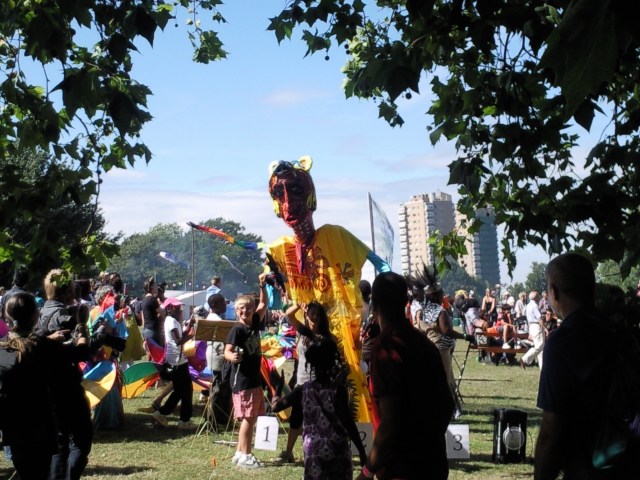
Here’s a girl dancing in front of a parade that popped up out of nowhere while we were buying books for 20p each from the library van:

And here’s another shot of the same parade:

According to the South London Press, 180,000 people attended the show over the two days. So it was doubly odd to find myself back there this morning, one of perhaps half a dozen people whose daily business takes them into Brockwell Park at 7am. It looked empty and silent, but also kind of beautiful:

Forget Cyprus, I never want to live away from here.

(The full sets of photos are here and here.)

Onward and upward

Dang. I was so close to being right about Holland winning the World Cup! But I’m glad Spain won it, because they deserved to, and because I have more Spanish than Dutch friends. Although I have just inspected my bank balance and it turns out the cash I would have won had Holland beaten Spain would have been very useful (payday is Thursday). Oh well.

Anyway, I’m going to move on and pretend none of it ever happened, and I’m going to start looking forward to the event of the year, the Lambeth Country Show at Brockwell Park this weekend. The Lambeth Country Show is worth our council tax on its own. There’s live music, actual animals, jousting, fruit and vegetable shows, craft stalls, cake, cider, a funfair and sheep-shearing demonstrations. It is the most fun in the world, and it’s all free and on my doorstep. Who needs holidays?

Outdoor gladrags

Last Sunday was the hottest of a run of hot days in London. It was also the day the England football team lost to Germany in a 4-1 thriller in the second round of the World Cup, Kevin Pietersen’s 30th birthday, and the third and final day of Hard Rock Calling, the misleadingly-named music festival which this year featured, among other hard rockers, Stevie Wonder, James Morrison, Crowded House, Elvis Costello and Crosby, Stills and Nash.

But it was the promise of Paul McCartney which had me eagerly pressing the “refresh” button on my browser the morning tickets went on sale. I tried to get tickets to see him at the Dome back in December, but the good seats were insanely expensive and anyway, it sold out before I could buy any. Day tickets to Hard Rock Calling are £60 and you get to sit anywhere you like and see lots of other acts, so this was a much better choice.

Well, it was great and the photos are here, but in the long minutes between acts I found myself fascinated by what people choose to wear when it’s hot and they’re going to be outside all day, because if you live in or near London (or any British city), neither of those things is very often true. It’s hot today, but I am spending eight hours of it inside an air-conditioned office, so I am wearing a dress with sleeves. On Sunday, we were all exposed to bright sun and 30C temperatures for about the same amount of time. In those circumstances, deciding what to wear can be quite tricky. So I inspected the choices of some of my fellow revellers, and have come up with some guidelines, which I now present to you for free, with nothing in mind but your welfare and happiness:

1. As in so many areas of life, I agree with Baz Luhrmann. Rule number one is wear sunscreen.

2. With no shade and barely a cloud in the sky, hats are the order of the day:

people in hats
3. Be careful with straps. Straps are good, but ill-fitting or competing straps are bad. However, if you have no choice but to show off your bra straps, do it with chutzpah, so it looks like you meant it:

lady with straps

4. It’s better to wear too many clothes than too few. You recover faster from being hot than you do from being burnt (I have tried both, so I can say this with certainty). And if you wear light, loose clothes you probably won’t be much hotter than you would have been in a bikini. I liked this outfit very much:

5. Do not, under any circumstances, wear a bikini. Bikinis are strictly for the beach.

I should come clean at this point and tell you that I was wearing a jumpsuit.

In many ways they are ideal hot-weather outdoor wear: they are durable, you can sit cross-legged without risking your modesty, and they keep all the ungainly bits covered while allowing arms and legs unfettered access to the air. However, they can be tricky to go to the toilet in. I think the answer to this is to wear a baggy-ish one with no complicated fastenings, and to stay on the fuzzy side of sober. You’ll be pleased to know that I more or less managed both.

However, based on extensive research I have decided that the IDEAL festival-going hot-weather outfit is a strapless top, elasticated shorts, a hat, sunglasses, sunscreen and a wrap which you can sit on when your legs get tired and put around your shoulders after the sun goes down.

Shoes are more problematic: you need something sturdy and comfortable which you won’t get sweaty in. I wore Crocs, but I am the only person I know who looks good in Crocs, and the only reason I think I look good in them is that I never on any account look at them once they’re on. I just revel in the squish of the tread and the swish of the air as it cools my toes. The real answer is probably flip-flops on soft grass and light plimsolls on rough grass. But I will leave that to your discretion.

Sorry for only talking about girls’ clothes. I have no advice for boys, although the hat and sunscreen rules are unisex. If you are a boy, I suggest you dress like this:

dancing man in bandana

I have left the most important rule, not including the sunscreen one, until last. The most important rule, not including the sunscreen one, is:

6. Wear whatever you like. It’s a festival! Go wild.

For a week or two

I am going on holiday tomorrow. To here:

Last night, I dreamed that it was tomorrow morning, and I’d forgotten to print the boarding passes before leaving work. Then I realised, in my dream, that we were flying from King’s Cross, which meant we could print everything at the beloved’s nearby workplace, so it was all alright. Then the alarm went, and I realised we’re not flying from King’s Cross (I think you have to have special permission to fly anything out of N1) but from Gatwick. Shit, I thought: we won’t be able to print the tickets and now we can’t go on holiday. It took a couple of minutes’ early morning panicking before I realised it was still Monday, so I hadn’t missed my chance after all.

I think I really, really need this holiday.

That aside, this Monday morning was better than most, partly because today is my last day at work for a bit and partly because I had accidentally left the radio on Magic FM, which I’d turned over to on Saturday when I was feeling exuberant and in need of something to sing along to. Being woken up by Islands In The Stream is one hundred times less stressful than having to listen to John Humphrys being unnecessarily aggressive at half past seven in the morning. But if I don’t listen to Today, what will I blog about? One to ponder from that terrace over the next few days.

Comic fiction

I am irrepressibly, unforgivably drawn to books written by comedians. I know they’re mostly awful, but I can’t seem to help myself. I think it all started when I read Ben Elton’s Stark, which I will still staunchly defend even though I’m slightly embarrassed about having enjoyed it so much. The law of diminishing returns applies to an almost painful degree to the subsequent follow-ups, but Stark was good.

I have also read:

Getting Rid of Mr Kitchen (Charlie Higson)

It’s Not A Runner Bean, Reasons To Be Cheerful and What’s Going On? (Mark Steel)

The Fountain At The Centre Of The World (Rob Newman)

Time For Bed, Whatever Love Means and The Secret Purposes (David Baddiel)

Paperweight, The Liar, The Hippopotamus, Making History, The Stars’ Tennis Balls and Moab Is My Washpot (Stephen Fry)

The Gun Seller (Hugh Laurie)

Frank Skinner (Frank Skinner)

Without Feathers (Woody Allen)

No Cure For Cancer (Dennis Leary)

Are You Dave Gorman? (Dave Gorman)

Billy Connolly (Pamela Stephenson)

I’m sure there are more; that’s off the top of my head. As you will know if you’ve read them all too, this list is a mixture of fiction, biography, scripts and other collected writings. As you will further know, quite a lot of them are not very good, and some of them aren’t even funny. But that somehow never puts me off, so when I went to see Jeremy Hardy and Jack Dee talking as part of Lambeth Readers’ and Writers’ festival a couple of weeks ago I should have known I’d end up buying more  books by comedians.

The talk took place at West Norwood library, which turns out to have a fully functional theatre tucked away in the back room. After the interviews the floor was opened up to questions, and as I wavered Englishly in the back row, wondering whether I had the balls to raise my hand, someone else got in with the question I was going to ask.

“Is it easier to write a book if you already know how to write stand-up, or are they two completely different skills?”

Jack said that it wasn’t very different for him, because he deliberately wrote his book in the style of his stand-up. Having read it, I can now confirm that this is entirely true. Reading it is more or less exactly like reading a Jack Dee stand-up script, except that occasionally he says something very earnest, usually about god, and you anxiously wait for the punchline before realising he means it. There are some good jokes in between, though, and a cheering photo of Jack aged four wearing exactly the expression he always has.

I found Jeremy Hardy’s book more engaging. For a start, it isn’t a straight piece of autobiography but a family history, so it’s not really very much about him. I know comedians like to talk about themselves, but it’s refreshing when they talk about other people too.

But then, Jeremy Hardy has always struck me as unusually humble for a comedian. Another question someone asked was “which other comedians do you admire the most?”. Jack Dee gave the usual answer, which is always some combination of Monty Python, Spike Milligan, Peter Cook and Morecambe and Wise. This is a popular answer because it says “I only admire the very best, and nobody of my generation is better than me.” So I was completely charmed when Jeremy Hardy chose Mark Steel, Daniel Kitson and Jo Brand. Not only are they his contemporaries, they also all live round the corner from him. He didn’t pick unassailable icons; he picked his mates.

The book is likeable and well-written, and also moral and thoughtful. In the end he decides that it doesn’t really matter who you’re descended from, or where they lived, but that there is real human joy in meeting people and forming relationships with them, whether they’re distant relations you haven’t seen in forty years, children who aren’t biologically related to you but whom you love none the less for it, or just the friendly folk at Arundel Castle who help you look up some records on a rainy day.

I also got both books signed. Well, I was there. I can report that Jeremy wrote “To Laura, love Jeremy Hardy”, but that Jack slightly trumped him by adding a little kiss underneath.
Northanger Abbey and Mansfield Park

Warning: do not read the below if you haven’t read either of these books, because I will almost certainly accidentally tell you who ends up married to whom.

Having finished and only quite enjoyed Emma, I’m not sure why I immediately picked up Northanger Abbey, but I did and I’m glad, because I loved it. It’s a bit disjointed, but it’s funny and pacy and has characters who are either comically awful or likeable and charming – especially the heroine, Catherine Morland, who is the most engaging heroine I’ve come across since Anne of Green Gables. And for once she falls in love with someone who actually sounds attractive, rather than with a pompous buffoon. Good.

I was less keen on Mansfield Park. For one thing, it’s really long, and though structurally it makes more sense than either Northanger Abbey or Emma, there’s lots that feels repetitive. For another, the heroine is a pissy, prissy little wimp. I kept hoping that her saintly self-sacrifice and po-faced piousness were hiding something more interesting, but no. Fortunately, she gets to marry someone quite as mealy-mouthed and solemn as herself, presumably so that they can spend eternity pointedly disapproving of everyone else. Good for them, but I wasn’t sure the 400 pages it took me to get them there were worth the time I spent on them. And although there are nasty characters, there are no laughs. It reads rather like one of the dreary but morally improving novels which Austen is so wittily rude about in Northanger Abbey. Perhaps she lost her cheek as she got older and more ill.

I still have Persuasion and Sense and Sensibility to read, but I think I’ll give myself a short break from Jane Austen first. Last week I accidentally bought three science books, so I might read one of those next, after which I’ll no doubt be desperate to fling myself back into the world of matrimony and means (one of the books should have been called that. Actually, all of the books could have been called that).

Air rage

When we awoke on Thursday morning to the news that flights across northern Europe had been grounded because of a cloud of ash from an erupting  Icelandic volcano, nobody was quite sure what to think. It was inconvenient, certainly, but it was also kind of exciting. Invisible volcanic ash in the sky!

For a couple of days, the radio news switched between election stories and volcano stories, and somebody (I thought it was Jon Snow on Twitter, but I can’t find a reference) pointed out how unusual it was for a news story this big to have nothing to do with any human agency; with nobody knowing or able to affect what would happen next. There were mutterings about the might of mother nature.

Then, yesterday, broadcasters got bored of talking about nature and decided they needed somebody to blame. A representative from an airline was invited on to the radio to explain that his colleagues had been running test flights all weekend, and the planes had been coming back unharmed. A presenter on the Today programme (I was a bit asleep, so I’m not sure who, sorry) crossly asked Lord Adonis (the transport secretary, not a classical superhero) why UK airspace wasn’t open yet, if it was safe to fly. Lord Adonis explained that the Met Office’s test flights, identical to the airlines’ except that they had instruments with which to measure the density and distribution of volcanic ash in the atmosphere, showed that it was not yet safe to send planes up. This morning, the programme was asking whether the government had mishandled events and acted too hastily in banning all flights.

Well, I don’t know about you, but I’d rather be stranded than dead. Air travel is one of the areas in which it’s never ever OK not to err on the side of caution, and were flights to be allowed in and out of the UK sooner than expected, the same sniping presenters and pressmen would have been asking whether the government had acted too hastily in allowing flights and putting travellers’ safety at risk.

So they can’t win. And I am once again faintly depressed by the press’s need to automatically challenge every decision the authorities make, just for the sake of it. Challenge political decisions by all means, or at least ask for them to be explained. But nobody has acted with anything other than good and honest intentions here. The various meteorologists, engineers and elected representatives whose responsibility it is to come up with a plan have been in constant discussions since this thing started, and personally I am happy to assume that (a) they know their jobs better than I do, and (b) none of them has a vested interest in wrecking the livelihoods of airline workers or in sending unwitting air passengers on flights of doom.

Unfortunately the Today programme isn’t designed to give us information so much as to create controversy where none exists, so this story has become a fight when it didn’t need to.

Of course, there are thousands of people undergoing inconvenience and expense because they’re stuck somewhere they don’t want to be, and the effect on some businesses is potentially huge, and there are people missing weddings and funerals, and maybe not getting home in time to see someone before they die. It’s not any fun. But although as individuals we feel a sense of injustice when bad things happen to us for no reason, as a society we need to be able to see that there is no reason, rather than desperately seeking a scapegoat. And the press, especially the publicly funded and accountable BBC, has a duty not to succumb to hysteria, but to take a measured view of what the situation actually is.

On a more selfish note, I find myself entranced by the sight of a London sky without vapour trails. As it happens we are having an unusually clear and dry April, so the effect is even more pronounced. The sky above Brixton has never looked like this in my lifetime, and it probably never will again:

(Sorry for slightly crappy photo, it was taken with my slightly crappy phone.)

Emma

As I approached the entrance to Brixton tube yesterday morning, I had a train of thought which went like this:

Please don’t try to give me a copy of Stylist magazine, please don’t try to give me a copy of Stylist magazine…you bastard! Why didn’t you try to give me a copy of Stylist magazine? Is it because you think I look like a MAN?

After I stopped reading Stylist for the fun of spotting the typos (it gets old quite quickly), I started reading it for the content, but that only lasted a week because it’s full of exortations to spend lots of money on really stupid things, and I am going through one of my periodic phases of disgust at the amount of stuff I have. When I moved from north London to south London three years ago under dramatic circumstances, I left everything behind. Well, almost everything – I kept my clothes, my books and my piano. I moved into a rented room in Brixton and felt the peculiar lightness that comes with leaving everything behind, including most of your responsibilities. I have new responsibilities now, ones I chose myself rather than picking up by accident, but I still don’t have that much stuff. I don’t need any new stuff.

So Stylist magazine isn’t for me. Sometimes I pick up a copy of Metro and read the celebrity gossip, the Nemi cartoon (I am the only person in the world who likes it, but I like it enough to make up for all those other people) and the football pages, along with anything else that catches my eye, but that lasts for less than half of my commute. So I read my book. At the moment, my book is Emma, and it’s the first Jane Austen I’ve attempted as an adult. And it’s sweet and funny and I’m enjoying it, but good grief, everything that happens is flagged up at least fifty pages in advance. And then there’s a hundred pages where actually nothing happens at all. I think it’s the perfect example of style overcoming substance.

Belly

I am losing weight. I think it’s because now that it’s light on my commute, I am walking to and from Brixton tube every day rather than taking the bus. It’s barely a mile away, but I suppose it adds up.

Anyway, looking at myself sideways-on in the mirror this morning (I do this a lot; I am pretty certain I know what I look like from every angle better than anyone else, with the possible exception of the beloved), I noticed that the curve of my belly has shrunk, and that unless I slump a bit, it doesn’t really stick out any more.

Well, that’s OK: I am officially overweight anyway (though I think I look fine), so it doesn’t matter if I lose a few pounds. And yet, I am a bit sad about my belly not being curvy any more.  Not as sad as I would be if my bum shrank, but close.

In my women’s group a few months ago we talked about weight and size and body image, having first read Fat Is A Feminist Issue and Lessons From The Fat-o-sphere: Quit Dieting And Declare A Truce With Your Body. The subsequent discussion was really interesting and raised all sorts of questions I hadn’t thought about before, including my own realisation that when I am thin, I assume nobody is going to take me seriously, and when I am fatter, I think I seem more important and worthy of consideration. At the time I wasn’t sure what that was about, but on reflection I think it might just be that when I put on weight I wear more sensible clothes, so I feel like a grown-up.

So maybe I should just dress more sensibly all the time! Except that without my miniskirts and heels I wouldn’t feel like me. There was a time in my life when I did dress sensibly, because I thought I needed to be a sensible person – and I hated it (it passed). It’s a tricky one, which I shall put aside for consideration another day, when I don’t have lots of work to do. Meanwhile, the sun is shining and I may celebrate the discovery that I’m not going to go overdrawn this month with the purchase of an unwisely revealing summer dress.

Me Cheeta

It took me ages to read Me Cheeta, mainly because I lost the first copy and had to wait while Amazon delivered a replacement. In the meantime I read Murder At The Academy Awards™ by Joan Rivers, which coincidentally was quite similar, except that it was rude about living movie stars rather than dead ones.

Anyway. To begin with I had a conceptual problem with Me Cheeta because I couldn’t quite work out what it was for. Why publish a fictional autobiography of a real animal? If it had no ambition other than to be funny, would that sustain 300-odd pages?

To begin with, I didn’t think it would. It’s full of scandalous stories about legendary Hollywood characters, but without knowing whether they’re true, false or vicious rumour I couldn’t quite bring myself to care about them. I had the same problem I have when I read fantasy novels (OK, I only tried it once), which was that without an anchor to something I recognise that tells me what’s real and what isn’t, none of it matters.

Except that bit by bit, it grew on me. There is a certain amount of scurrilous badmouthing of people who don’t seem to deserve it, but as it goes along it turns into something quite different – a love story, a poem, a tale of loss and loneliness, which is certainly made up, but now that we’re definitely in the realm of fiction that’s suddenly OK.

And there is some beautiful writing. You know when an image is so lovely you have to stop and drink it in for a few moments before you can carry on reading? Those images must be different for different people, and anyway they probably only work in context, but I’m going to share one with you all the same because I think it’s just perfect. Here’s Cheeta describing the view from the terrace of a movie star’s mansion:

The lawn that rolled your eye down to the inevitable rectangle of turquoise was as densely irridescent as a hummingbird’s breast. If you watched very closely you could see the dents left in it by the gardeners’ footsteps disappear slowly back into its sheen, like the marks of fingers on a human arm.

Isn’t that great?

And it is very funny, and very smartly written in places. And, well, the last chapter made me cry. So despite my initial misgivings, I am recommending it wholeheartedly.