This is really a New Year’s song, but it’s been adapted into English as the Carol of the Bells or the Ukranian Bell Carol, and is indelibly associated with Christmas over here and especially in the States where various English-language Christmassy versions exist (you may especially remember it from Home Alone, or that might just be me).
This isn’t the best video in the world, but it’s the most charming version musically, so I hope you forgive the shakiness. If not, you are allowed to cheat and watch the Muppets version instead.
You might not have heard of Carlos Galhardo, but in his day his lively radio hits made him a star in his home country of Brazil. Boas Festas was composed by his friend Assis Valente and first recorded in 1933, when Galhardo was just twenty. It took me a long time to find a Christmas song from South America that wasn’t Spanish or Portuguese in origin, but since Galhardo and Valente were both born in Brazil and lived there all their lives I think Boas Festas counts as authentically Brazilian.
I haven’t been able to find a convincing translation for the whole song, but I am fairly confident that the title translates as “Happy Holidays”. If you are good at Portuguese <COUGH Sam>, please feel free to send me a translation or stick it in the comments below. Otherwise, just enjoy the music.
This is the perfect song to start with. Not only is it from Lapland (well, Finland anyway), it is also absolutely lovely (especially from 1:50 onwards), and – this is my favourite part – it is about Tonttu the Christmas Gnome. Why don’t we have a Christmas gnome in the UK? Perhaps I will start a campaign.
There’s an English translation of the lyrics here (scroll down).
For this year’s advent calendar we are stretching our wings and travelling around the world in search of Christmas songs from twenty-four different countries. Some you will know, some you will know by a different name, some you will be delighted to hear for the first time and some you might not be. Europe is over-represented, but I think we’ve got something from every continent.
Good things come to those who wait. I waited twenty-one years for it, and this month my patience was finally rewarded when I got to see Carter USM, the best band in the world, play Brixton Academy, the best (big) venue in the world.
You’d think, wouldn’t you, that twenty-one years of anticipation would be too much to live up to? That now that I’m, frankly, 30 Something, and they are, well, older than that, the frenzied excitement and wild fandom of my teens might have faded, and the sparkle and energy of their live performances dulled? I’ve never seen them before so I can’t tell you it was as good as seeing them in 1991, but it was as good as I’ve ever imagined seeing them to be, and better. As good because it was as thrilling and lively and boisterous a show as you could hope for, and better because it hadn’t occurred to me until I had the evidence before me that south London is full of people who love Carter as much as I do, who know all the words and were having exactly the same amount of fun as me. I have always said that the reason radio will never be killed off by Spotify and its ilk is that there is something transcendent and intimate about being one of a group of people who don’t know each other all sharing the same musical experience, and if a DJ can do it then a band can do it times ten. The last time I wrote about them I said I liked to keep Carter as my own secret band, but it turns out that sharing them is even better.
Other things: this may be the first gig I have ever been to at Brixton where I didn’t drink anything more exciting than a Pepsi, and that was good too, because I was in a place I loved, full of people I loved, watching music I loved, and none of it was the fake love that a couple of vodkas inspires (“No, YOU’RE amazing”). I wanted to hug everyone there, and I still do.
(That said, we skipped out of the aftershow party quite quickly because we were tired and flaky, so we didn’t get to have our photos taken with the band themselves, but that’s probably for the best. If you shouldn’t meet your heroes, you definitely shouldn’t meet your superheroes, right?)
I posted this over here rather than over there because it’s not a review. It’s a thank-you note. To the band, to everyone who made the show happen, to Shona who bought me a ticket (and who has a photo of me, aged 15, in a knocked-off Carter t-shirt which was my pride and joy) and to everyone who was there on the night. I got beer spilled on my difficult-to-wash jumper and I lost my voice, and everything about it was perfect.
Long posts about writing and product management and corporate hierarchies are percolating somewhere in the back of my mind (bet you can’t wait!), but in the meantime I want to introduce you to what might be the best thing on the internet. Songtapper lets you use the space bar on your keyboard to tap out the rhythm of a piece of music, then tells you what the music is. Despite the name, it doesn’t just do songs – I have just used it to find out the name of Bach’s Toccata and Fugue in D Minor which, if you are like me, you will know better as that piece of music that Dracula would play on the organ, if he had one.
I don’t think it’s brilliant for very new music, but you can’t have everything and it’s still like having your most musically knowledgeable friend on hand day and night, ready to pop up with an answer whenever you can’t remember the name of the music from the Old Spice advert.
(You can learn more than the names of songs, too: it was Songtapper that led me to the discovery that parts of Daisy Bell and Funiculi, Funicula have almost exactly the same rhythm. I have also learned that knowing the name of a piece of music but not which advert I remember it from is almost more annoying than the other way round, and that O Fortuna features nowhere in The Omen, and the piece of music I vaguely remember as being from Carmina Burana is actually a specially-composed piece called Ave Satani, for which Jerry Goldsmith won an Oscar. Maybe it’s only me who had them confused, I don’t know. That said, the number of places where O Fortuna is used is mindboggling. No wonder everyone knows it without knowing why.)
I listened to Sleigh Ride this morning, because even though it’s not Christmas I was cold and tired and it is a song that never doesn’t cheer me up. It is also the most crazily complicated song in the world – if you are a musician, pick up your instrument of choice and try busking along with it and you’ll see what I mean:
But Dan says it’s too early to listen to Christmas music, so I turned it off and listened to some show tunes instead, and found myself shivering with glee at the lyrics to Thoroughly Modern Millie. I can’t decide whether my favourite is
Men say it’s criminal/What women’ll do
What they’re forgetting/Is this is nineteen twenty two!
Or
What we think is chic, unique and quite adorable
They think is odd and Sodom and Gomorrable
Both are pretty perfect. What song lyrics make you happy?
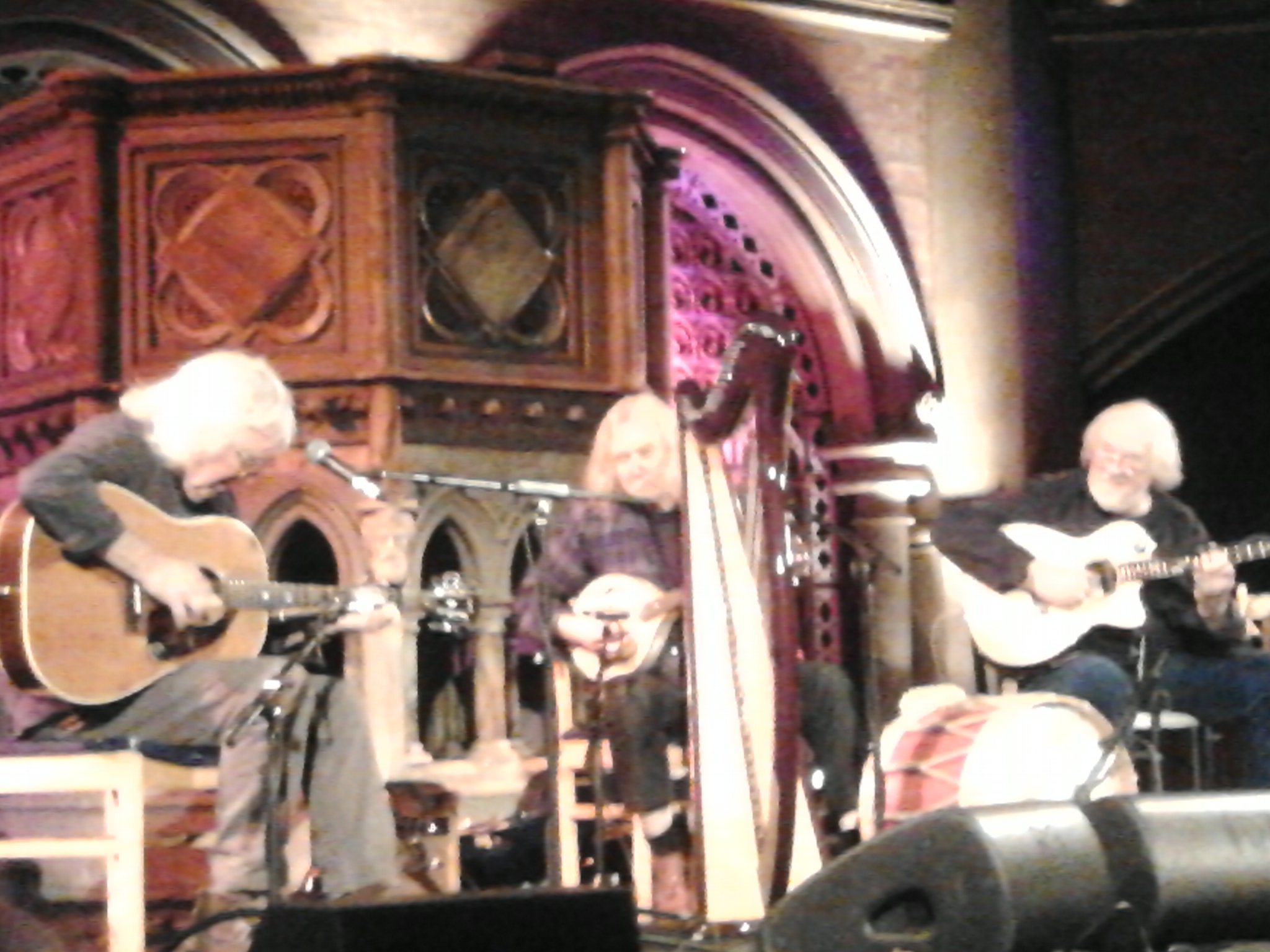
L-R: Wizz Jones, Robin Williamson, John Renbourn, on a crappy phone camera
When Bert Jansch died, I said here that I was going to make a list of the musicians I wanted to make the effort to see while I still had the chance. I never made the list, partly because it’s a bit morbid to try and come up with a list of musicians who you think might die soon, but mostly because I am lazy and don’t follow up on my promises.
But someone who would have been on the list, because he was a contemporary of Jansch’s, was John Renbourn, who I am delighted to say I saw perform on Saturday night at the Union Chapel, and my goodness, it was terrific. At the Union Chapel you can sit about twelve feet from the performers, so we did because when you are watching guitarists, you want to be able to see their fingers. John didn’t speak much (he had raconteur extraordinaire Robin Williamson, formerly of the Incredible String Band, to do that for him), but he made his guitar sing like a young Beach Boy, and seemed to do things with it that oughtn’t to have been physically possible. I am not a guitarist, but I had one seated either side of me, and they both agreed afterwards that there were notes in there which, even with three people playing (Wizz Jones was the third), seemed to come from nowhere at all.
There is music which is designed to take you outside of yourself – prog rock, trance, punk – and there are musicians who can transport you to somewhere entirely new (I always think that seeing Bobby McFerrin perform live is the closest thing we have to evidence for the existence of a higher plane). And then there is music which takes you deep down inside of yourself, and for me that is acoustic blues and folk guitar. Sitting in the Union Chapel with a cup of tea and my coat still on because try though they might, it is not a well-heated space, I seemed to live my life again in a series of images and memories which the music evoked. Not because they were songs I knew – less than half of them were – but just because the very sound of them spoke to a half-hidden part of me, where unremembered thoughts and feelings live.
I don’t think this is because I was a blues musician in a previous life, or because the music invokes supernatural presences: I think it’s because this is the music I heard before I heard anything else, and what it arouses in me is probably more or less the same set of feelings that any sudden sharp sensory link to my early childhood would, but that doesn’t make it any less interesting.
I count myself lucky to have been brought up by this music, because there is something timeless about it – I joked on the night that we were the youngest people there but we weren’t, not by a long way – and I’m not sure it would be the same if my earliest musical memories were of the Village People or Boney M. There are other types of music which transcend their time, of course – jazz, classical – but their time was earlier. Davy Graham, Bert Jansch and the three white-haired geniuses I saw at the Union Chapel were living, breathing artists when I first heard them, all the more so to me because the way I first heard them was not on vinyl or cassette but on wood and steel, tapped out by my dad on his own guitars. This music made me, and it was a privilege to be able to see it first-hand.
I didn’t record any of the show, because that would be rude, so here instead is a lovely video from the olden days.
Give up? You might as well, because you’re not going to guess. It’s that they all brightened up my lunchtime today, courtesy of the always-fascinating Letters of Note and its upstart sibling Lists of Note. Stop what you’re doing and read all three of them: it’s worth it.
If ever I am the subject of the Guardian Weekend magazine’s Q&A feature and I am asked “When and where were you happiest?”, I think the answer is going to be “in front of my laptop, watching this video”.
(If you are reading this on a phone, come back to it later and watch it on a bigger screen.)



 Glad All Over