The park again

I took this picture in the south-west corner of Brockwell Park yesterday. I love the city views, but I really like this one too, because you can pretend you’re in the countryside:

Talking of nature, we spent a couple of hours last Sunday afternoon in the back garden of the Crown and Greyhound in Dulwich Village, where we were protected from a brief bout of rain by this monster, whose branches extend so far across the garden that nobody got wet at all:

I think it’s a horse chestnut, but I would be happy to be corrected.

Sunday lunch at the Rosendale: a warning from history

I don’t write about restaurants very often, because most of the places I go out to eat are perfectly nice without being amazing, and thus not really worth mentioning, since I am not a food blogger. But I am making an exception for The Rosendale, because if I can save one person from enduring a Sunday lunch like the one I had yesterday, it will have been worthwhile.

Years ago, The Rosendale was a pub which did pizza. Good pizza – the type you’d travel for, although I only lived around the corner then, so I didn’t have to. Then I moved away, and by the time I came back it was a gastropub and getting good reviews all over the place. So we ate there, once, and it was good. But somehow it took us two years to go back, even though it’s a fifteen-minute walk from home, and this time, it was bad.

The service, to be fair, was only mediocre. After a long period during which nobody came to take our order (even though there were only two or three other groups there), we were presented with a basket of stale bread. Well, maybe it wasn’t all stale, but the piece I got was definitely past its best. As I spread it with butter so soft and tasteless it might have been margarine, I thought “they wouldn’t serve stale bread; this must be the texture it’s supposed to have”. But then I ate it, and no, it was just stale.

Next came beef carpaccio sliced so thickly as to look more like a couple of steaks, and a gazpacho soup so tart it set my teeth on edge, and such a disconcerting shade of ketchup-red that I could only assume it had come out of a tin. It was accompanied by greasy garlic croutons, which, in a charming touch of consistency, were also stale. What it didn’t come with was a spoon: I had to grab a waitress and ask for one.

The beloved’s main course of rabbit was, to give it its due, very good. My roast beef with all the trimmings, in contrast, was possibly the most inedible plate of food I have ever been presented with, not including the time a Spanish woman cooked me a pig’s trotter to welcome me to her home. The beef was tough and tasteless, the roast potatoes (which were the reason I’d ordered it) were dry and almost certainly reheated (or if not, then just very badly cooked) and, inexplicably, the Yorkshire pudding had the actual consistency of a mushroom. I’d noticed a plate going back into the kitchen with a barely-touched Yorkshire pud languishing on it, and at the time I’d thought “what kind of a maniac would leave a Yorkshire pudding uneaten?”, but in the end I had to do the same. The mixed veg had all been steamed together, which meant that the carrots were underdone but the broccoli and beans were fine, which was fortunate because they were the only part of it I enjoyed.

The puddings looked good, but we were too disspirited by the whole experience to stay and find out. At £40 a head for two courses with wine, they need to get better at cooking quite quickly. As for our Sunday lunch, the next time I want to leave the washing up to someone else I think I’ll head into Herne Hill for a perfectly adequate roast for half the price at The Commercial, or even a proper old-fashioned pub pizza at The Half Moon.

Lambeth Country Show 2010

I usually wring every last available drop of fun out of the Country Show, but this year, for a variety of reasons, I only spent a couple of hours there each day and as a result I felt I missed quite a lot of it. I went to bed last night feeling faintly sad and anxious at not having spent more time there, like a child who suddenly realises that when she wakes up it won’t be Christmas any more.

But when I awoke this morning I remembered that it’s quality, not quantity, that counts; and this year’s show was one of the best I can remember. The weather was perfect – sunny and warm but not hot – and the music was super (Alabama 3 in particular were brilliant, as they always are); the atmosphere was better than ever and despite record attendance it felt completely relaxed and friendly everywhere I went. It was nothing at all like that year that we had to dive out of the way of a bunch of teenagers trying to stab another bunch of teenagers. (But then, I was child-free this year, so I didn’t have to go to the funfair.)

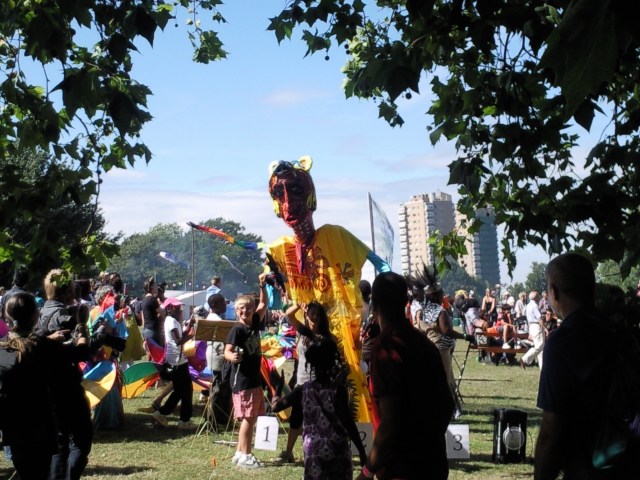
Here’s a girl dancing in front of a parade that popped up out of nowhere while we were buying books for 20p each from the library van:

And here’s another shot of the same parade:

According to the South London Press, 180,000 people attended the show over the two days. So it was doubly odd to find myself back there this morning, one of perhaps half a dozen people whose daily business takes them into Brockwell Park at 7am. It looked empty and silent, but also kind of beautiful:

Forget Cyprus, I never want to live away from here.

(The full sets of photos are here and here.)

Onward and upward

Dang. I was so close to being right about Holland winning the World Cup! But I’m glad Spain won it, because they deserved to, and because I have more Spanish than Dutch friends. Although I have just inspected my bank balance and it turns out the cash I would have won had Holland beaten Spain would have been very useful (payday is Thursday). Oh well.

Anyway, I’m going to move on and pretend none of it ever happened, and I’m going to start looking forward to the event of the year, the Lambeth Country Show at Brockwell Park this weekend. The Lambeth Country Show is worth our council tax on its own. There’s live music, actual animals, jousting, fruit and vegetable shows, craft stalls, cake, cider, a funfair and sheep-shearing demonstrations. It is the most fun in the world, and it’s all free and on my doorstep. Who needs holidays?

Lost in translation

The beloved and I took a speedboat ride up the Thames yesterday evening. I would heartily recommend it – it’s very exciting – but it does do interesting things to your hair. There were only six of us on the boat, plus a captain and a guide, and once we got past Tower Bridge we went super-fast, accompanied by the theme tunes from Baywatch and then James Bond. It was brilliant, and I was only a tiny bit scared.

Then we ate at Caffe’ Vergnano on the South Bank. I really like it there, but it’s somewhere I have usually gone before a film or a show, so I tend to go early and it’s always fairly empty. Last night we were there later on, and it was very busy. Halfway through our meal they seated a couple so close to us that it was nearly impossible for me to leave my seat without crashing into their table. It added an element of challenge to the evening, but it also gave us the chance to listen in to their conversation. Actually we had no choice: she was more or less completely silent, but he had a great booming voice that drowned out the sound of the trains just feet above our heads. Sadly they were speaking a language I didn’t recognise – I don’t speak many languages, but I can recognise the sound of a lot of them, and this wasn’t one I knew. It might have been Portuguese, or one of the eastern European languages that has nothing to do with Russian.

Anyway, I don’t know how much I would have enjoyed listening to him had I known what he was saying, but listening with no idea what he was talking about was great fun. He had a peculiarly mirthless laugh with which he punctuated every sentence. Because I didn’t recognise the words he was using, I have attempted to reproduce them phonetically, to give you an idea:

Amazon turquoise Lithuanian bathtub. Ha. Ha. Ha. Ha. Malevolent projector foolproof simian pilot. Ha. Ha. Ha. Ha. Ha. Christmas fettucine bones, bananas and bra. Ha. Ha. Ha.

It was disconcerting, but also kind of fascinating, and loud enough that it was easier for us to listen to him than attempt a conversation of our own. She sat in silence opposite him, occasionally joining in with the solemn laughter. I tried to imagine what he might be saying. The tone implied that it was probably something like

We have trapped your father in a dungeon. Ha. Ha. Ha. Ha. If you do not tell us where the jewels are he will die. Ha. Ha. Ha. Ha. Ha. We will show him no mercy. Ha. Ha. Ha.

But I think that was just the way he spoke. He was probably saying

Look at these jokers next to us. Ha. Ha. Ha. Ha. They are listening to me instead of having a conversation of their own. Ha. Ha. Ha. Ha. Ha. And they both have hair that points vertically upwards. Ha. Ha. Ha.

Sunshine in Bermondsey

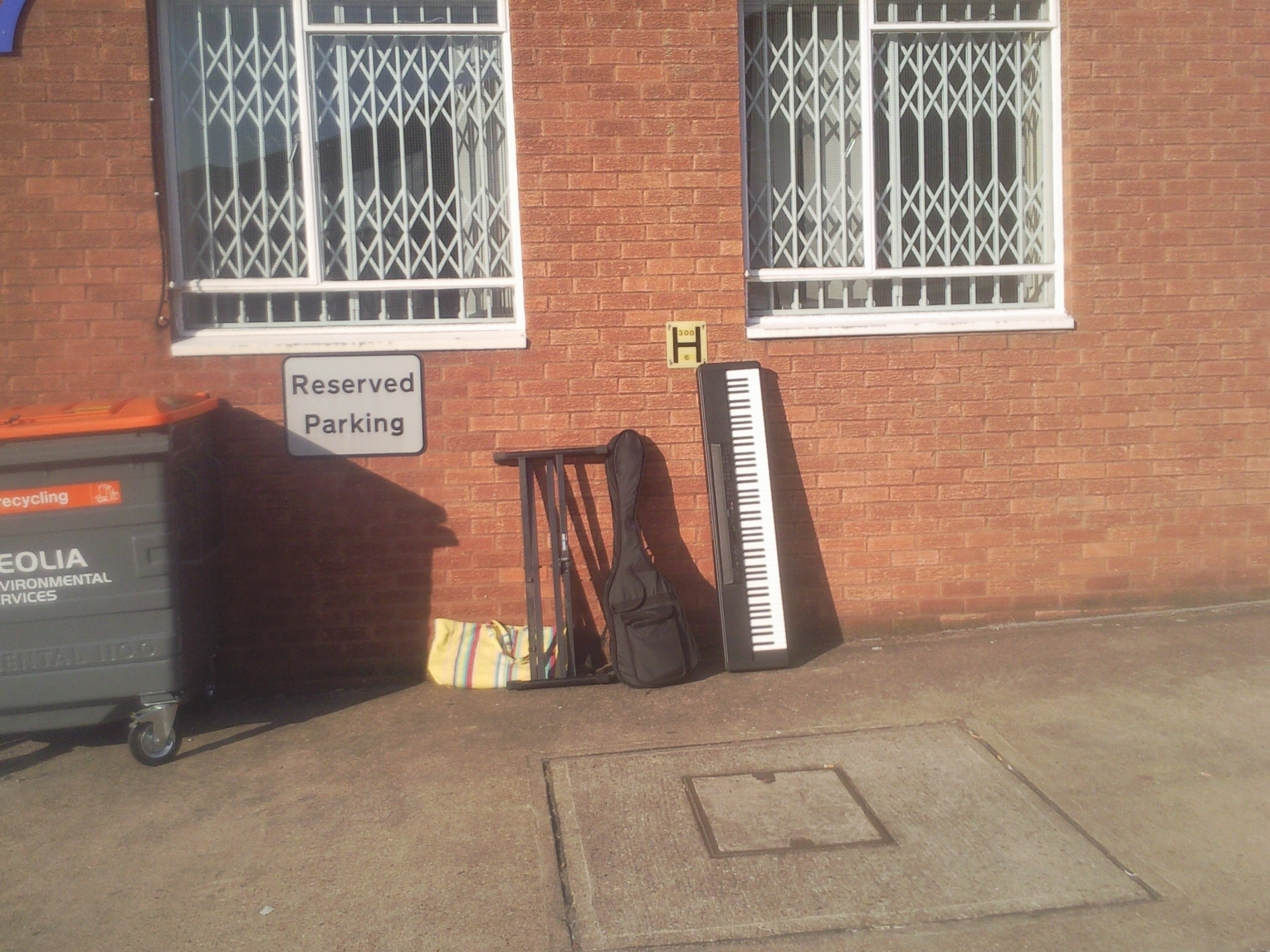
It was both discourteous and misguided of me, I now realise, to assume that it’s always raining in Bermondsey. Yesterday was our final rehearsal for the wedding that we’re playing music at this weekend, so back we all trooped to the Bermondsey Trading Estate, which this time around was bathed in bright sunlight:

bermondsey trading estate

The equipment stood there for about five minutes, while we waited for a cab. When we picked up the keyboard, it was almost too hot to hold. It’s good to have new experiences from time to time.

Donatello and the eggs

I can’t remember why I decided to study art history at university, but I know exactly why I decided to do it at Essex. I can still visualise that line in the 1994 prospectus, glittering with romantic possibilities:

In the second year, as part of the Renaissance Art and Architecture module, students will make a ten-day study trip to Florence.

When I was seventeen the furthest I’d been from home was France, or possibly Wales. The prospect of a paid-for trip to Italy – to Florence – sounded impossibly, dazzlingly exciting. So I applied to Essex, and was invited in for an interview, in advance of which I removed a sling from my injured arm at my mother’s insistence (“if you go in wearing a sling, all they’ll remember about you is the sling”), and was eventually offered a place. I still didn’t quite believe I’d ever really make it to Florence (Florence!), but there was plenty to get excited about in the meantime.

The trip drew near. “Bring warm clothing”, read the set of instructions which we were all sent before Christmas. “Italy can be quite chilly in January.” “Bollocks”, I thought. “It’s Italy. Of course it’ll be hot.” I packed sun dresses and cardigans. We flew to Florence. It was freezing. We spent ten days freezing, drinking coffee and wine, visiting churches, eating pastries, sleeping for four hours a night, looking at art, falling in and out of love with each other and drinking more wine. I was nineteen and it was everything I had hoped for.

Back in Wivenhoe, we had bonded. We had told each other all our deepest secrets, made each other laugh and cry, and swapped all of our clothes. We wrote essays together and shared textbooks. The one book we each had our own copy of, because it was only £6.99 (I have it here, so I know) was Vasari’s Lives of the Artists, published in 1550; an extraordinarily personal and vital account of the lives of the people whose work we’d encountered in Florence, some of whom Vasari actually knew. As interesting for what it told us about Vasari as for what it revealed about its subjects, it was a book we all knew inside out. And our favourite story was the story of Donatello and the eggs. I’ll let Giorgio tell it himself:

[Donatello] made a crucifix over which he took extraordinary pains. When he had finished it, convinced that he had produced a very rare work, he asked his close friend, Filippo Brunelleschi, for his opinion. But Filippo, in view of what he had already been told by Donatello, was expecting to be shown something far better;  and when he saw what it was he merely smiled to himself. At this Donatello begged him for the sake of their friendship to say what he thought of it. So Filippo, being always ready to oblige,  answered that it seemed to him that Donatello had put on the cross the body of a peasant, not the body of  Jesus Christ which was most delicate and in every part the most perfect human form ever created. Finding that instead of being praised, as he had hoped, he was being criticized, and more sharply than he could ever have imagined, Donatello retorted: “If it was as easy to make something as it is to criticize, my Christ would really look to you like Christ. So you get some wood and try to make one yourself.”

Without another word, Filippo returned home and secretly started work on a crucifix,  determined to vindicate his own judgement by surpassing Donatello; and after several months he brought it to perfection. Then one morning he asked Donatello to have dinner with him, and Donatello accepted. On their way to Filippo’s house they came to the Old Market where Filippo bought a few things and gave them to Donatello, saying: “Take these home and wait for me. I shall be along in a moment.”

So Donatello went on ahead into the house, and going into the hall he saw, placed in a good light, Filippo’s crucifix. He paused to study it and found it so perfect that he was completely overwhelmed and dropped his hands in astonishment; whereupon his apron fell and the eggs, the cheeses, and the rest of the shopping tumbled to the floor and everything was broken into pieces. He was still standing there in amazement, looking as if he had lost his wits, when Filippo came up and said laughingly:

“What’s your design, Donatello? What are we going to eat now that you’ve broken anything?”

“Myself,” Donatello answered, “I’ve had my share for this morning. If you want yours, take it. But no more, please. Your job is making Christs and mine is making peasants.”

We loved this story. It had everything: friendship, conflict, local colour and domestic catastrophe. It made the artists seem human in a way that nothing we’d seen or read before had done. When exam time rolled around we made a pact: we would all try and get the story of Donatello and the eggs into one of our exam answers, somehow. It was a silly story and no doubt we’d all be marked down for including it where it wasn’t relevant, but we didn’t care. We were nineteen.

On the day of the exam, we were all slightly giggly. We entered the exam room. We started to feel nervous (I have an anxious feeling in the pit of my stomach right now, reliving it). We turned the papers over. The first question read:

What evidence is there for rivalry among Renaissance Florentine artists?

The room rippled with suppressed laughter as we all tried to avoid catching one another’s eyes. I don’t think I’ve ever enjoyed an exam so much in my life.

Bath, Box and points west

Forgive me if I seem a little distracted: I’ve just returned from a weekend in the countryside, and it’s left me so calm I’m almost unconscious.

February is a difficult time to take a weekend break in the UK, because it’s too cold to visit the seaside (though we did it anyway this time last year) and the best attractions in the cities are often still closed for the winter. But after a busy few weeks at work and at home the time seemed ripe for a weekend away, and somehow the various options were whittled down until we had arrived at Bath as our intended destination.

Well, I would never stay at a hotel which wasn’t recommended by tripadvisor.com, and Foggam Barn B&B in Box, a village five miles outside Bath in Wiltshire, had better recommendations than any other guest house in the area, so we booked for a two-night stay. The first pleasant surprise came when I told the owner, Denise, that we’d be arriving by the five o’clock train and taking a taxi from Bath. “Don’t take a taxi,” she emailed; “I’ll come and pick you up from the station”. And she did, and dropped us off again yesterday, and gave us a lift to the restaurant a mile away where we ate on Saturday night.  She also put fresh flowers, chocolates and champagne in our room, unprompted and at no extra cost, and cooked us two very nice breakfasts. Ten out of ten for Foggam Barn.

We spent most of Saturday and part of Sunday in Bath itself. It’s quite as beautiful as everyone tells you it is, with no shortage of interesting things to do. The baths themselves are fascinating, and in places quite enchanting. Also warm, which had become a key consideration to me at this point. Everywhere outside London is colder than I expect it to be.

Afterwards, we tramped up the hill to take a look at the Circus and Royal Crescent, both of which I was keen to see, avid student of architecture that I, um, used to be. The Royal Crescent in particular is possibly more impressive at a distance than up close, the beauty of the individual buildings somewhat obscured by decades of dirt. You would think there would be cash available for the basic maintenance of a world heritage site, but what do I know? The overall effect is still very impressive, and a flat in the Royal Crescent remains on the list of properties I will consider buying when I come into my millions.

Next, we visited the Jane Austen Centre, just down the hill on Gay Street and a few doors away from the house where Austen lived with her mother and sister for a few years in the early 1800s. The rosy-cheeked lady behind the counter told us to take our tickets and wait upstairs in an ante-room. “Your guide will join you there shortly”, she announced grandly. We duly took our tickets and trooped up the rickety stairs to a small room where we watched a film of an unnamed man stripping to his pants. I think he then dressed up in Regency costume, but to be honest with you the memory of his hairy white belly is all I’ve managed to retain. Sorry.

Eventually, the double doors ahead of us swung open dramatically. “Hello”, said the same rosy-cheeked lady who had sold us our tickets a few minutes earlier, “and welcome to the Jane Austen Centre. Please take your seats in here ready for the introductory talk”.

We walked into the front room, elegant with its bay window and original fittings. Chairs were set out in rows, all of which bar the front and the back were filled before we got there. “Shall we sit at the front?”, I asked my beloved. “Let’s sit at the back”, he replied, and thank goodness, because if I struggled to keep my subsequent giggles at bay whilst hidden safely away in the back row, I don’t know how I’d have coped had I been within inches of the rosy-cheeked lady, who proceeded to give us a talk in the style of a Hitler parody delivered by somebody whose first language is not English. I wish I’d had the presence of mind to make an audio recording, because I can’t possibly do it justice in writing. She had obviously learned the whole thing from a script, and either had no interest in the subject matter or was so awkward about public speaking that she couldn’t work out where to place the emphasis. Sentences were cut off midway, dramatic pauses occured in the most unexpected places, sections were entirely incomprehensible and the whole thing was delivered at high volume and in a rattling style that would make an army major proud. It was brilliant. Particularly enjoyable was the fact that in her mind she had so completely separated the words in her script from anything she might say of her own accord that the speech ended like this:

Robotically: “…so thank you for visiting the Jane Austen Centre.”  Pause, breath. Brightly: “Thank you for visiting the Jane Austen Centre!”

Next, we were herded through to a third room where we got to watch another video, this one a knowing turn from actor Amanda Root, full of quizzical looks to camera and lines like “it’s easy to imagine Jane sitting in the window of this house…witty, wise and ironic”. If you say so, Amanda.

The reason for the elaborate preamble became evident as we made our way into the permanent exhibition, which contains – well, nothing. There are some costumes from screen adaptations (but none of the ones you’ll have seen), reproductions of portraits of Austen and various members of her family, and a few photos of modern Bath residents and Austen fans (and she does have fans, in the way that only certain writers seem to) pretending to be at a ball. And that’s it. It’s the most curiously content-free exhibition I think I’ve ever been to, which is not to say that I didn’t enjoy it. The whole visit was terrific fun, but perhaps not quite in the way intended.

There are Colin Firth-as-Mr Darcy fridge magnets on sale in the shop, which I think makes up for everything. I wish I’d bought one and I can’t think why I didn’t. Two excellent meals and a good night’s sleep later we arrived back in Bath with five hours to kill before our train home, so we had a walk around the city centre, stopped for a cup of tea and then went to see A Single Man, in which Firth stars as a bereaved lover, his more dramatic scenes punctuated by whispered “phwooooaaar”s from the beloved.

The only blot in an otherwise perfect landscape was provided by the local bus services, which seem to be operated by two rival companies. We bought return tickets into Bath on Saturday morning but our driver failed to warn us that the return halves would only be valid for one in four buses running on the return route, so we had to buy new tickets for the journey home. We ended up spending £17 on bus fares that day, which seems extortionate, especially when compared with London prices for public transport. But I’ll forgive Bath and the surrounding district for its shoddy bus service on the grounds that everything else was a delight, and there is almost nothing as cheering as waking up to the sound of a cock crowing (quiet at the back, there). When I’m a grown-up I’m going to go and live in the countryside (as long as I can live somewhere where I can still go to the theatre, and get the Guardian delivered, and buy milk at 3am, and won’t get snowed in).
Bookshop dilemma

A new bookshop has recently opened in Herne Hill, which has for the first time caused me to question my highly successful “no new books” policy. We already have an Oxfam shop with a good selection of books, and I am a library member and anyway have a pile of about thirty unread books sitting in the flat, all of which are good reasons for not buying any new books at all, let alone new books at full price, which in Herne Hill Books they mostly are.

And yet. I’d like them to do well, and not have to close down in six months’ time because everybody thinks the same way as me. Apart from anything else, you can’t give library books or Oxfam books as presents, so it’s useful to have somewhere nearby available for emergency birthday purchases when I’ve left it too late to go anywhere else.

I solved this dilemma temporarily today by buying a copy of East of Acre Lane, which since it’s set locally seemed an appropriate purchase, even though it broke the rule. And I think I have a good ongoing solution too, which is to order my book club books from there, since they are exempt from the rule, being too hard to find by other means. I just have to remember not to accidentally buy a pile of four extra books each time I go in to place an order. I will let you know how I get along.

But right now, I have to go: it’s Ronnie O’Sullivan v Mark Williams in the snooker semi-final. Shh.

Goodbye to Peckham

Tomorrow sees the consolidation of my stuff and the beloved’s into a single location. I love my egg, and I’m delighted that we will be able to stop having the “Where are we going tonight? Is there any food at your place? I’m not sure I’ve got clean socks there” conversation, but I will miss being a part-time courtesy Peckham resident. Here, as a goodbye, are my favourite things about Peckham:

  • Peckham Library is a beautiful thing, and really the heart of the town centre in a way that the architects must have hoped for but couldn’t have predicted. Peckham is slowly, stealthily, undergoing a gentrification of the subtlest kind, and the library is the best and biggest symbol of it. It is also the site, approximately, of the Sunday farmer’s market, source of excellent meat and veg.

  • The all-night off licence on Asylum Road: the source not merely of late-night emergency wine, but of really nice late-night emergency wine, because the owner is a wine enthusiast and specialises in buying the last few bottles in discontinued lines, so that he gets them at a knockdown price which he then passes on to his customers.
  • Morrison’s supermarket. I am not a Morrison’s connoisseur so perhaps they’re all like this, but Peckham Morrison’s is so big and glossy and colourful that it’s more like a proper American supermarket than the inferior English version. They sell everything you could think of, and plenty that you couldn’t. I think I could live for a year in Peckham Morrison’s and eat something I’ve never tried before every day.
  • The neighbours on the road we will shortly be departing are almost uniformly friendly and charming. This is unique in London, in my experience. At least, I had very nice neighbours in Dulwich once, but Dulwich is different. Plus, they were ladies of a certain age who were more or less guaranteed to give no trouble, whereas there’s much more of a mix here. But people say “hello” as you walk past them, and put Christmas cards through the door, and yesterday one said “let me know if you need any help moving; I’m really good at packing boxes!”. What nice people they are. What a shame to leave them behind.

Our neighbours in Herne Hill, on the other hand, do at least provide excellent anecdote material.