Paris

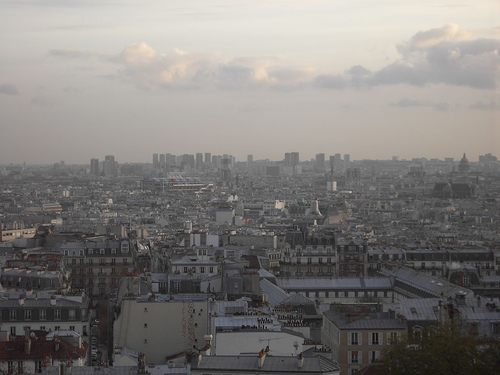
…was still lovely, of course. We caught the sun on the first day and I realised I hadn’t been there in good weather since 1998. It makes walking with no particular purpose in mind much more appealing.

In my second, or maybe third, year at university, I wrote an essay about Haussman’s Paris, and the period between 1853 and 1870 when he, along with Napoleon III,  was responsible for what amounted to a wholescale razing and rebuilding of large swathes of the city. Huge numbers of slum-dwellers were effectively banished; their homes replaced by shiny new apartment buildings which only the rich could afford to live in. This is still the main reason why Paris’s inner city, in the sense in which we use the term, is largely outside the city.

Anyway, one of the things Haussman succeeded in putting in place was a set of rules governing future development in the city, which meant that subsequent building projects have had to abide by the aesthetic rules devised during his period as Prefect of the Seine. As a result, one of the most immediately Parisian of images is the wide, tree-lined boulevard edged with elegant buildings of greyish-white stone, never more than five stories high.  This is the Paris that Haussman defined, and it’s still there much as he envisaged it.

And yet, there’s more variation in Paris than you might think, and it’s the sudden differences as much as the general sameness which make it a beautiful city. Not just the Eiffel Tower and the Centre Pompidou, but the unexpected sights which lurk around every other corner: a flea market; a gloomy courtyard, usually occupied by a grumpy-looking cat; a carousel; a sudden sharp hill leading up, or down, to a new vista. Paris does human-scale street life better than any city I can think of off the top of my head, with the possible exception of Beijing.

And it has La Grande Arche de la Défense, which is really big and has a hole in it:

grande archeMore photos here.

Gay Paree

paris

I’m off for three days of eating, drinking, eating, walking and eating. I fall in love with Paris all over again every time I go, including the time when I went with both my siblings, and my brother had to come a day late because his passport had expired, and my sister got food poisoning and puked all the way home.

Have a lovely bank holiday weekend, unless you’re outside the UK, in which case just have a lovely weekend. Or is May 1 a holiday everywhere?

Taipei 101 revisited

There was a programme on BBC2 this evening about Taipei 101, the counterweighted skyscraper I wrote about a few months ago.  If you can endure Richard Hammond (who, separated from the others, is fairly inoffensive, though I prefer the wild-haired one and have no time at all for Clarkson), it’s worth checking out on the iPlayer.  The show focuses on the various feats of engineering which went into the building’s construction, and I was pleased to discover that the story of the building is just as fascinating as the finished product.

It also has the world’s fastest elevator, which travels at the unlikely speed of 1010 metres per minute.  I’ve had my ears pop in Japan’s fastest elevator, in the Yokohama Landmark Tower, but at a piffling 750 metres a minute it barely compares.  (Though looking it up now I discover that it’s also the world’s second-fastest elevator.)

Anyway, I’ve never been to Taiwan, though I’d like to,  so I don’t have any photos of Taipei 101.  Instead, here’s a photo of the view from the top of the Yokohama Landmark Tower, reflected in a mirror inside the viewing gallery:

landmark

Shanghai Tower

After a series of stories about mooted and improbable mile-high buildings, it’s almost a novelty to read about one which is actually being built as we speak.  The new Shanghai Tower will be a respectable 632 metres tall, making it the tallest building in China.  What I like most about this story, though, is the way the illustrations make Shanghai look as though it’s either in space, or the future, or both.

Yet another tallest building in the world

Soon, you won’t even need to get in a plane to join the mile high club, if plans for this unlikely-looking structure in Dubai go ahead (alright, it’s a kilometre high.  That’s ONE KILOMETRE).

Here, courtesy of Device Daily, is a chart comparing it to various other buildings around the world.  If you squint, you might just be able to make out Canary Wharf over there on the right:

http://devicedaily.com/wp-content/uploads/2008/10/nakheel-tower-09.jpg

In praise of Croydon

I found myself in Croydon town centre a week or two back for the first time in years.  It’s de rigueur to deride Croydon, and I expect you think I’m still going to, but whenever I’m there I remember why I think it’s got one of the best-designed centres of any town I know.  It’s not wildly pretty, true, but it has its moments (the old hospital on the corner of the high street and George Street is one; the station at East Croydon is another), and most of all, it just works.  Whether you come in on foot, in a car or by public transport the system is designed to get you to where you want to be quickly and with the minimum of fuss.  The high street is pedestrianised along most of its length, and there are two indoor shopping centres (the Whitgift is older and a little more run down; Centrale, which replaced the old Drummond Centre, has a silly name but almost all the shops anyone could want to visit), so that it’s an uncomplicated and stress-free place to shop whatever the weather or time of day.  The main car parks are just behind or under the high street and cars are deposited there via a system of bypasses and tunnels, so that pedestrians and vehicles rarely meet one another, which can only be a good thing.  And the public transport is a dream: there are three mainline stations, countless buses and a speedy and reliable tram network (run by those good folk at TfL).

And it still has an Allders.   Bromley’s Allders, where you could buy almost everything, became a giant Primark.  Croydon’s goes from strength to strength.  Sometimes all you need is a shop with a really good haberdashery department.

New skyscraper for Paris

The centre may be for the most part the same as it was when Georges-Eugène Haussmann introduced his planning reforms in the 1850s, but in other parts of Paris all kinds of interesting things are happening.  La Défense, to the north-west of the centre, is the city’s business district and has the highest concentration of skyscrapers of any urban area in Europe.  Since the 1980s the most striking of these has been La Grande Arche, which is brilliantly and thoughtfully designed so that it lines up with the Arc de Triomphe and the Arc de Triomphe du Carrousel, whose name I never knew before today, meaning that if you stand in the Tuileries gardens you can look straight through all three of them, over a distance of several miles.

But today inhabitat has designs for a new, ecologically-minded skyscraper which is about twice the height of the Grande Arche (though still smaller than the Eiffel Tower – some things are sacred) and which looks great.  I’m very happy to live in a time when people have discovered that buildings don’t have to be square or rectangular.  We’re building pyramids and pods as well as star-shaped cities and Teletubby houses.  It all makes London’s shard of glass seem almost pedestrian.